"Autobiographies of great nations are written in three manuscripts – a book of deeds, a book of words, and a book of art. Of the three, I would choose the latter as truest testimony." - Sir Kenneth Smith, Great Civilisations

"I must write each day without fail, not so much for the success of the work, as in order not to get out of my routine." - Leo Tolstoy

I have never believed that one should wait until one is inspired because I think the pleasures of not writing are so great that if you ever start indulging them you will never write again. - John Updike

"The life of every man is a diary in which he means to write one story, and writes another; and his humblest hour is when he compares the volume as it is with what he vowed to make it." - J.M. Barrie, Peter Pan

Poetry is the shadow cast by our streetlight imaginations." - Lawrence Ferlinghetti


[Note - If any article requires updating or correction please notate this in the comment section. Thank you. - res]


Showing posts sorted by date for query re slater - meditations. Sort by relevance Show all posts

Wednesday, January 28, 2026

Virgil's Aeneid and the Tragic Cost of Empire Building


Illustrated by R.E. Slater & ChatGPT

Beneath the Shadow of Empire
Virgil’s Aeneid and the Tragic Cost of Empire Building

by R.E. Slater & ChatGPT

“Imperium sine fine dedi.”
I have granted them empire without end.
- Virgil, Aeneid 1.279

“The true subject of history is not power, but suffering.”
- Simone Weil

“Great art does not console. It makes visible.”
- adapted from Albert Camus


Preface

Every civilization eventually tells itself a story about how it began. Not merely to remember, but to justify. Not merely to preserve, but to persuade.

These stories become more than memories. They become mirrors - reflecting what a culture believes itself to be, and what it hopes others will see. They are sung, taught, monumentalized, and repeated until they feel inevitable.

Rome told its story through Virgil.

Commissioned during the fragile dawn of Augustus’ new imperial order, the Aeneid was tasked with doing what few works of art are ever asked to do: to gather scattered histories, myths, and aspirations into a single poetic architecture capable of sustaining an empire’s self-understanding.

Yet the poem that emerged does something far more complex than stabilize power. It unsettles it.

The Aeneid does not merely narrate Rome’s rise. It exposes the human cost embedded within the very idea of historical destiny. It does not deny greatness, but neither does it allow greatness to appear morally weightless. Instead, Virgil composes a work in which triumph is inseparable from grief, vocation from loss, and founding from fracture.

This essay approaches the Aeneid not as a singular monument to Rome’s glory, but as one of the earliest sustained meditations on what it means to build worlds - and what such building extracts from those who bear its burden.

Introduction - A Poem Commissioned, a Conscience Discovered

Virgil’s Aeneid has long occupied a paradoxical position in Western literature. It stands simultaneously as Rome’s national epic and as one of the most quietly subversive poems ever written in the service of political power. For over two millennia it has been read as the story of origins: how a Trojan refugee named Aeneas, guided by fate and the gods, journeyed from the ruins of Troy, through many obstacles, to the soil of Italy and became the ancestor of the Roman people. It is, in this sense, a poem about national beginnings.

Yet to read the Aeneid only as an origin story is to miss its deeper ambition. Beneath the architecture of legend lies a sustained inquiry into the moral psychology of founding itself. Virgil is less interested in explaining how Rome began than in asking what kind of inner world must exist for such a beginning to be possible.

The poem emerges from a moment of acute historical tension. Rome in the late first century BCE had been torn apart by decades of civil war. The old republican order lay in ruins. Augustus, victor over Antony and Cleopatra and heir to Julius Caesar’s legacy, presented himself as the restorer of peace, tradition, and moral stability. Yet this restoration depended upon a radical concentration of power unprecedented in Roman history.

Augustus needed more than armies and laws. He needed meaning. He needed a story vast enough to render the present not as a rupture, but as fulfillment.

Virgil’s task, therefore, was not merely literary. It was civilizational.

He was asked to craft a poem that would do for Rome what Homer had done for Greece: provide a shared imaginative homeland, a moral grammar, and a vision of collective destiny. The Aeneid was to be beautiful, authoritative, and persuasive. It was to sanctify Rome’s past and stabilize Rome’s future.

And yet, according to ancient tradition, Virgil approached his own creation with profound unease. On his deathbed he is said to have requested that the poem be destroyed, as it was unfinished and unpolished in his eyes. Whether or not the story is historically exact, its symbolic force is unmistakable. The Aeneid bears the marks of a poem that knows it is walking a perilous line between celebration and confession.

What makes the Aeneid enduring is not that it tells Rome what it wants to hear. It is that Virgil finds a way - through narrative, character, and tragic structure - to tell Rome what it cannot afford to forget.

This essay explores the Aeneid as a work suspended between legend and lament, between imperial aspiration and human cost. It argues that Virgil constructs not a simple hymn to empire, but a tragic epic in which civilization itself becomes a morally ambiguous achievement: magnificent, necessary, and deeply wounded.

Rome, in Virgil’s vision, is not founded upon innocence.
It is founded beneath the shadow of loss.


I. The Aeneid as Epic Form and Cultural Technology

Epic poetry in the ancient world was never merely storytelling. It functioned as what might be called a cultural technology: a device for preserving memory, shaping moral imagination, and stabilizing collective identity across generations. Long before archives, printing presses, or national museums, epic served as the primary medium through which civilizations remembered who they were and why they existed.

Homer’s Iliad and Odyssey did not simply recount heroic exploits. They encoded Greek values - honor, excellence, hospitality, cunning, endurance - into narrative form. To learn Homer was to learn what it meant to inhabit the Greek world.

Augustus understood this dynamic intuitively. A restored Rome without a restored story would remain fragile. Laws could compel behavior; armies could enforce order. But only a shared imaginative vision could cultivate loyalty, meaning, and long-term coherence.

The Aeneid was therefore conceived as more than a literary masterpiece. It was intended as Rome’s moral archive and national inspiration.

Virgil adopts Homeric architecture deliberately. The poem’s first half follows a wandering hero displaced from home, echoing Odysseus. The second half narrates a brutal war over territory and destiny, echoing Achilles. Through this structural mirroring, Rome is inserted into the deepest layer of Mediterranean mythic memory. Rome does not merely come after Greece. Rome is woven into the same primordial fabric.

Yet imitation is not equivalence.

Virgil transforms the epic form even as he inherits it. Homeric epics revolve around heroes pursuing personal honor within a competitive aristocratic world. Virgil’s epic revolves around a hero who repeatedly suppresses personal desire in service of a future he will never see. The gravitational center of the genre shifts from glory to obligation.

This shift reflects Rome’s own mythic self-understanding. The Roman ideal is not the dazzling individual warrior, but the citizen who subordinates himself to the collective project. Discipline, endurance, and submission to national identity replaced Homeric flamboyance.

And yet, Virgil refuses to present this transformation as uncomplicated moral progress.

The epic form allows him to hold two visions in tension at once:

  • On the surface, Rome emerges as history’s destined culmination.

  • Beneath the surface, the poem continually stages scenes in which that destiny wounds those who must enact it.

In this sense, the Aeneid does not simply function as cultural technology. It becomes a meta-technology: a device that exposes the costs hidden within cultural technologies themselves.

Virgil shows how civilizations require stories that smooth over rupture, disguise contingency, and transmute violence into necessity. But he also shows - quietly, persistently - that such smoothing never fully succeeds.

As a mythic Epic, in Virgil’s hands, becomes a form capable of containing contradiction.

The poem teaches Romans how to see themselves as heirs to Troy, chosen by fate, and entrusted with world-rule. Simultaneously, it teaches attentive readers how fragile such narratives are, and how much suffering they depend upon.

This dual function explains the strange emotional texture of the Aeneid. The poem is solemn rather than exuberant. Its beauty is weighted, its grandeur haunted. Even its victories feel heavy.

Unlike Homer, who often delights in the kinetic energy of battle and the immediacy of heroic presence, Virgil writes with retrospective gravity. His epic sounds as though it already knows that empires rise and fall, that glory erodes, that monuments eventually become ruins.

Thus, while Augustus sought a poem that would anchor Rome’s future, Virgil produced a poem saturated with historical consciousness.

The Aeneid does not simply project forward. It looks outward, backward, and inward at once.

It looks backward toward Troy, outward toward Rome’s imperial horizon, and inward toward the human psyche struggling to survive inside vast historical machinery.

This is why the Aeneid continues to feel modern.

It is not content to tell us who wins.

It asks what winning does. Why it may not be important. And the enduring burden that winning brings.


II. Virgil and the Artist Under Power

Virgil did not write the Aeneid from a position of political freedom. He wrote under patronage, under expectation, and under the quiet but unmistakable pressure of an emerging autocracy. Augustus did not merely admire Virgil’s talent; he depended upon it.

This dependence fundamentally shapes the poem’s character.

Unlike poets who compose in overt opposition to power, Virgil occupies a far more precarious space: the artist whose work is desired by power. Such a position offers protection, resources, and prestige - but it also creates an ethical trap and personal risk. When authority wishes to be praised, silence can be dangerous, and direct critique can be fatal.

Virgil’s genius lies in recognizing that resistance need not be noisy to be real.

Rather than writing against Augustus, he writes around him. He constructs a poem that satisfies the formal requirements of imperial ideology while embedding within it layers of emotional and moral disturbance that prevent any fully triumphalist reading.

This mode of writing belongs to a long tradition of what might be called interior dissent: art that fulfills its public function while quietly complicating the values it appears to endorse.

Virgil’s earlier poetic career makes this stance intelligible. His pastoral poems dwell in small-scale worlds - shepherds, fields, love, and loss. His Georgics, while ostensibly a manual on agriculture, already function as a meditation on labor, suffering, and the dignity of sustained effort. Even there, the Roman ideal of work is portrayed as necessary-but-exhausting, ennobling-but-relentless.

The Aeneid intensifies this trajectory.

Where the Eclogues explore fragile beauty, and the Georgics explore disciplined endurance, the Aeneid explores what happens when endurance becomes a permanent condition rather than a temporary trial.

Virgil is not a revolutionary. He does not imagine a Rome without empire. But neither does he imagine an empire without moral cost.

His relationship to Augustus is therefore neither simple loyalty nor covert rebellion. It is tragic complicity.

Virgil knows that Rome’s historical momentum cannot be stopped. He also knows that art can still shape how that momentum is understood.

The poem does not shout: Empire is evil.

It whispers something more devastating:

Empire may be necessary.
Empire may even be magnificent.
But empire is never clean.

This is why the Aeneid feels saturated with grief even when it is celebrating destiny. Virgil writes as a man who understands that historical success and human flourishing are not synonymous.

In doing so, he transforms the role of the court poet.

Rather than functioning solely as an amplifier of power, Virgil becomes a surreptitious recorder of what power leaves behind.

He catalogs the abandoned, the displaced, the silenced, and the inwardly broken - not in the language of political protest, but in the language of tragedy.

This distinction matters.

  • Political critique seeks to persuade.
  • Tragic art seeks to reveal.

Virgil’s aim is not to overthrow Augustus’ narrative. It is to make that narrative heavy with self-awareness.

  • If Rome must tell itself that it is chosen, Virgil ensures that chosenness feels burdensome.
  • If Rome must imagine its origins as glorious, Virgil ensures that those origins are soaked in tears.

The rumored desire to burn the poem thus becomes symbolically fitting. The Aeneid reads like a work that never wanted to become an official monument. It wanted to remain a question.

And perhaps this is Virgil’s final act of fidelity - not to Augustus, not even to Rome, but to humanity itself.

He gives the empire its epic.

He also gives posterity its conscience.


III. Aeneas: The Anti-Homeric Hero and the Psychology of Subtraction

Epic heroes traditionally embody a culture’s highest aspirations. Achilles embodies heroic excellence and incandescent individuality. Odysseus embodies cunning intelligence and resilient selfhood. Both figures are intensely self-aware. They know who they are, what they desire, and what they are willing to risk.

Aeneas is a different kind of hero.

He does not blaze.
He does not dazzle.
He endures.

Virgil’s central innovation is to construct a protagonist whose greatness consists not in the expansion of self, but in its gradual erosion.

Aeneas is introduced as pius Aeneas - the pious one, the dutiful one, the bearer of obligation. From the opening lines, his defining trait is not charisma or brilliance, but burden. He carries the gods, the future, the ashes of Troy, and the expectations of an unborn civilization.

Yet what is striking is not simply that Aeneas bears these weights, but that he never fully understands them.

Unlike heroes who receive clear instructions and confidently execute them, Aeneas moves through a fog of partial revelation. He knows he must go somewhere. He knows he must found something. But the contours of that destiny remain indistinct. The gods communicate through riddles, dreams, fragments, and delayed disclosures.

This narrative choice is critical.

Virgil could have written a hero who marches forward with certainty. Instead, he writes a hero who advances through uncertainty.

Aeneas’ psychological posture is therefore not triumphal but anxious. He is frequently described as trembling, grieving, hesitant, and exhausted. His internal landscape is dominated less by ambition than by endurance.

Over time, this endurance produces a particular form of damage.

Aeneas becomes increasingly capable of suppressing his own interior life. He learns how to override desire, mute grief, and subordinate love to necessity. This is not portrayed as moral failure. It is portrayed as training.

But training exacts a price.

Virgil quietly stages what might be called a psychology of subtraction: with each act of obedience, something human is pared away.

Aeneas does not grow into a more vibrant self.
He grows into a more functional self.

He becomes reliable.
He becomes effective.
He becomes colder.

This trajectory culminates in the second half of the poem, where Aeneas increasingly resembles a machine of fate rather than a fully integrated person. He conducts killing campaigns with grim efficiency. He exhibits less hesitation, but not more joy. The cost of certainty is emotional narrowing.

The hero does not become whole.
He becomes usable.

This is perhaps Virgil’s most unsettling suggestion: that civilizations may require founders who are, in a profound sense, incomplete.

Not wicked.
Not monstrous.
But hollowed out.

Aeneas’ virtue is real. His sacrifices are genuine. Yet Virgil refuses to romanticize the interior consequences of a life lived entirely for posterity.

Aeneas will become the ancestor of Rome.
He will never become himself.

In this sense, Aeneas is not simply Rome’s founding father. He is Rome’s first casualty.

His interior diminishment prefigures the ethical structure of the civilization he enables: disciplined, formidable, outwardly magnificent, and yet... inwardly costly.

Virgil thus redefines heroism.

Heroism is no longer the flourishing of the individual within a meaningful cosmos.
Heroism becomes the willingness to disappear into history.

This redefinition is not presented as noble simplicity.

It is presented as tragic necessity.

And tragedy, for Virgil, is not spectacle.

It is recognition.


IV. Dido: Love, Alternative Civilization, and the World That Might Have Been

If Aeneas embodies the civilization that must be, Dido embodies a civilization that could have been.

Virgil does not introduce Dido merely as a romantic obstacle. He introduces her as a ruler, a founder, and a visionary. She has fled tyranny, gathered refugees, organized a city, established laws, and cultivated prosperity. Carthage, as Virgil presents it, is not a barbaric outpost. It is ordered, vibrant, industrious, and humane.

In other words, Dido has already accomplished what Aeneas has not yet achieved.

This narrative choice is radical.

Virgil allows the hero to encounter a functioning civilization that is not sanctioned by Roman destiny.

This alone destabilizes any simple notion that Rome represents the only viable path toward human flourishing.

Dido’s Carthage operates through cooperation rather than conquest. It arises from mutual protection rather than prophetic inevitability. It is built through shared vulnerability rather than cosmic mandate.

When Aeneas arrives, he does not enter chaos... he enters possibility.

Their relationship, therefore, is not merely erotic. It is philosophical.

Together they imagine a joint future: a shared rule, a merged people, a city formed not through annihilation of the other but through relational synthesis. Virgil carefully presents this not as fantasy but as a plausible alternative history.

This is what gives the episode its devastating force.

Dido does not represent temptation alone.

She represents an alternative model of civilization.

One grounded in presence rather than postponement.
One grounded in mutual recognition rather than deferred destiny.
One grounded in love rather than abstraction.

When Aeneas leaves Dido, he is not simply abandoning a lover.

He is abandoning an altogether new world - one that never was and never could be under Roman rule.

Virgil intensifies this tragedy by granting Dido a full interior life. She speaks extensively. She reflects, argues, remembers, hopes, despairs. Her voice fills the poem with psychological density unmatched by any other character in the Aeneid.

This imbalance is deliberate.

Lavinia, the Italian woman Aeneas is destined to marry, never speaks.

Yet Dido speaks hundreds of lines.

The woman associated with political necessity is silent.

The woman associated with human intimacy is eloquent.

Virgil thereby exposes the poem’s moral fault line: history privileges outcomes over experiences, but poetry refuses to do so.

Dido’s suffering is not presented as hysterical excess. It is presented as coherent, intelligible, and devastatingly human. She believes herself married to Aeneus. She believes herself chosen. She believes herself building a shared future.

From her perspective, Aeneas’ departure is not obedience to fate - It is betrayal.

Virgil does not correct her. - he allows the reader to inhabit her devastation without offering theological consolation.

Even Aeneas’ defense - that he must follow destiny - sounds thin against the wreckage it produces.

When Dido kills herself, the poem does not frame the act as moral failure - It frames it as consequence to stoic loyalty to a cause and not to her.

A world in which destiny overrides love becomes a world in which certain people become unviable... even unlivable.

This is not a side note.

It is the emotional core of the epic.

Dido’s death plants a permanent question inside Rome’s origin story:

What kind of civilization requires the sacrifice of such a woman?

Virgil never answers this question.

But he ensures that it cannot be forgotten.


V. The Underworld, the Two Gates, and the Fracture of Historical Certainty

Midway through the Aeneid (c. 29-19 BCE), Virgil brings Aeneas to the underworld. Structurally, this moment mirrors Odysseus’ descent in the Odyssey (c. 750-700 BCE) and anticipates Dante’s later journey centuries later in the Divine Comedy. (c.1308-1320 CE) But Virgil’s underworld serves a distinct purpose.

It is not primarily a place of moral judgment - It is a place of historical revelation.

Here, Aeneas encounters the shade of his father, Anchises, who unveils the future: a grand procession of Roman heroes yet to be born, culminating in Augustus and his destined heirs.

This vision supplies the poem with its most explicit articulation of Rome’s cosmic mission. Rome is not merely powerful. Rome is (divinely) chosen or fated to become. Its dominion is presented as both vast and endless.

On the surface, this scene appears to fulfill the epic’s ideological function.

The hero sees the meaning of his suffering.
The future justifies the present.
(Mythic) destiny becomes (imaginatively) visible.

Yet Virgil introduces a detail so strange, so disquieting, that it destabilizes the entire vision:

Aeneas does not exit the underworld through the gate associated with true dreams.
He exits through the gate of false dreams.

The ancient tradition behind the two gates distinguishes between visions that correspond to reality and visions that deceive. By directing Aeneas through the gate of false dreams, Virgil introduces interpretive instability at the very moment when certainty should be maximal.

This is not an accidental flourish - It is a philosophical incision.

The implication is not necessarily that Rome’s future will not occur. Historically, from Virgil’s vantage point, it already has occurred. The implication is more disturbing:

The way Rome understands its future may be false:
The grandeur may be real.
The victories may be real.
The moral interpretation of those realities may be illusory.

Virgil thus suggests that civilizations are capable of generating accurate outcomes and inaccurate meanings simultaneously.

Empires happen - But. the stories empires tell about themselves are curated.

This fracture between event and interpretation is one of the poem’s most modern insights. It anticipates later critiques of ideology, propaganda, and myth-making without employing any of that vocabulary.

By having Aeneas forget the vision after leaving the underworld, Virgil compounds the instability. The hero does not march forward illuminated by certainty. He returns to the world burdened by obscurity.

The future has been shown - It has not been integrated.

Aeneas continues not because he understands, but because he must.

This distinction matters.

It suggests that Rome’s founding is not driven by transparent moral clarity, but by momentum, pressure, and obedience to inherited narratives.

The underworld episode thus becomes a mirror of Virgil’s own historical position.

Augustus claims that Rome has entered an age of restoration, peace, and moral renewal.

Virgil allows that claim to stand.

But he embeds within the poem a quiet warning:

A future proclaimed as radiant may still be constructed atop accumulated suffering.

Destiny, in the Aeneid, is not false.

But it is not innocent.

The two gates remind us that history’s self-understanding is always vulnerable to distortion.

And poetry, at its best, is the art that leaves that vulnerability visible.


VI. The Ending: Mercy Withheld, Justice Questioned, Empire Founded in Fury

From the beginning of the Aeneid, the reader knows how the story must end.

Aeneas will prevail.
The Trojans will secure a homeland.
Rome will be birthed.

There is no narrative suspense about outcome. The only suspense that remains is moral. Virgil reserves that suspense for the final moments:

Aeneas and Turnus, champion of the Italian resistance, meet in single combat. Turnus is defeated. He falls. He is disarmed. He is helpless. The war has effectively ended.

At this point, epic convention would normally grant the hero a moment of magnanimity. The victorious founder, standing at the threshold of history, would demonstrate the virtue that legitimizes his rule.

Virgil deliberately stages such a moment.

Turnus speaks.

He does not rage.
He does not curse.
He pleads for his life.

He acknowledges defeat. He accepts that Aeneas has won Lavinia and the future (of Rome). He asks only that his life be spared, or at minimum that his body be returned to his father.

Crucially, Virgil tells us that Aeneas hesitates. He wavers. He begins to incline toward mercy.

This hesitation is not incidental. It is one of Augustus’ most publicized virtues: clementia mercy, restraint, the capacity to spare the defeated. Augustus cultivated an image of himself as a ruler who, unlike the warlords of the civil wars, knew when not to kill.

Aeneas stands poised to embody this same ideal.

Then Virgil reverses the scene.

Aeneas sees Turnus wearing the belt of Pallas, the young warrior entrusted to Aeneus' personal care who had been slain earlier in the war by Turnus. The sight triggers an eruption of rage. Aeneas no longer speaks as a political founder. He speaks as an avenger of Pallas, his symbolic son, ward, and protege. 

He viciously kills Turnus. Aeneus is merciless.

Not as a calculated necessity.
Not as an act of judicial closure.
But in violent, blood fury.

Virgil’s language is explicit. Aeneas is seized by madness, by burning anger, by a surge of personal passion. The killing is emotionally intelligible.

It is not morally clean.

The poem dramatically ends at this very moment.

There is no celebration.
There is no reconciliation.
There is no vision of peace.

The final word describes Turnus’ soul descending to the underworld indignant - wronged, feeling undeservedly treated, deprived of justice.

With this ending, Virgil performs a devastating maneuver.

He allows Rome to be founded - But he refuses to let Rome be founded innocently. The city comes into existence not through an act of mercy, but through an act of rage.

This does not mean Aeneas is a villain. It means Aeneas is human. And this humanity is precisely what unsettles the epic.

If Rome’s first decisive act is morally compromised, then moral compromise is not an aberration in Roman history. It is structural.

Virgil does not say that empire is illegitimate. He suggests something more difficult: Empire is tragic.

Not tragic in the sense of melodrama. Tragic in the classical sense: a collision between a fated destiny that cannot be harmonized.

Aeneas owes loyalty to the dead.
Aeneas owes mercy to the living.
He cannot fully satisfy both.
Whatever he chooses, something sacred is violated.

The founding of Rome thus occurs in a moral remainder. Something unresolved. Something that cannot be redeemed by later greatness.

The poem’s final silence is therefore not emptiness. It is accusation. Not against Aeneas alone. Not against Augustus alone. But against the very logic that insists history must always justify itself.

Virgil leaves us not with triumph - He leaves us with responsibility.


VII. Virgil’s Legacy: From Roman Epic to Christian Conscience

Virgil did not live to see what his poem would become. Within decades of his death, the Aeneid entered Roman education as a foundational text. Children learned Latin through its lines. Statesmen quoted it. Philosophers glossed it. It became not merely a great poem, but a cultural organ.

Yet the most remarkable dimension of Virgil’s legacy is not Roman.

It is Christian.

As Christianity spread through the late antique world, early Christian thinkers found themselves inheriting a literary tradition saturated with pagan epic. Rather than discard Virgil, they reinterpreted him. They sensed in the Aeneid not theological correctness, but moral seriousness.

Virgil did not know Christ. But he knew tragedy. And tragedy proved to be an existential bridge to meaning. To identity. To virtue and value.

Christian readers recognized in Virgil a poet who understood that history is broken, that power wounds, that innocence is rare, and that human greatness is always compromised. These intuitions resonated deeply with a religious worldview centered on fallenness, suffering, and the longing for redemption.

This reception reaches its most famous expression in Dante’s Divine Comedy. Here, Dante literarily chooses Virgil as his guide through Hell and Purgatory. This choice is not ornamental.

Virgil had come to represent natural reason at its highest reach. He embodied what the human mind might grasp about justice, suffering, virtue, and moral order without divine revelation. He can diagnose evil. He can recognize tragedy. He can lead the pilgrim through the landscapes of moral consequence.

But Virgil cannot enter Paradise.

This limitation is symbolic. It is not a condemnation of Virgil. It is an acknowledgment of the boundary of tragic wisdom.... Virgil can show that the world is broken. He cannot show how to heal it.

In this sense, the Aeneid becomes, retroactively, a pre-Christian witness to humanity’s unresolved condition.

It knows that history cannot save itself.
It knows that empire cannot redeem its own violence.
It knows that duty alone cannot generate wholeness.
These are precisely the questions Christianity claims to answer.

Yet even here, Virgil’s relevance does not evaporate. Modern readers, whether religious or not, continue to encounter in the Aeneid a profound realism about power. The poem resists both naive glorification and simplistic condemnation. It occupies the harder space between.

Virgil teaches that civilizations are neither purely evil nor purely good.
They are tragic achievements.
They arise from genuine human longings for order, meaning, and continuity.
They also arise through exclusion, coercion, and cruel sacrifice.

This double vision remains indispensable. In an age still shaped by nations, empires, and global systems, the Aeneid offers no easy comfort. It offers something rarer:

  • Moral depth without moral illusion.
  • Virgil’s legacy, therefore, is not that he gave Rome its greatest story.
  • It is that he gave the West one of its earliest sustained examinations of what it means to need such stories in the first place. .

VIII. Conclusion: Founding, Suffering, and the Unfinished Human Question

The Aeneid endures because it refuses to simplify what it means to begin.

Rome’s origin story, as Virgil tells it, is not a tale of pristine emergence. It is a tale of flight, loss, compromise, and morally ambiguous necessity. Troy must burn. Dido must die. Pallas must fall. Turnus must be killed. Only then can Rome exist.

Virgil does not hide these costs.

He arranges them into the very architecture of the poem.

This is his quiet defiance.

The epic form had long been used to elevate nations, glorify heroes, and stabilize collective identity. Virgil uses the same form to introduce moral friction into those processes. He gives Rome its legend while ensuring that the legend remains ethically heavy.

The result is not cynicism - It is tragic clarity. Tragedy, in the classical sense, does not declare that life is meaningless. It declares that meaning is expensive.

Virgil understands that civilizations arise from real human desires: the desire for order rather than chaos, continuity rather than erasure, remembrance rather than oblivion. These desires are not contemptible. They are deeply human.

But he also understands that when such desires are organized into vast historical projects, they begin to demand sacrifices no single individual can fully consent to make.

Aeneas becomes the embodiment of this dilemma.
He is neither monster nor saint.
He is the man willing to become smaller so that something larger can exist.
In doing so, he reveals the tragic logic of empire itself.

Rome, as Virgil imagines it, is not evil. But neither is it innocent. It is a civilization born beneath the shadow of what it had to destroy. This shadow does not disappear when the city rises. It lengthens. It stretches across centuries. It follows Rome into its imperial height. It follows Rome into its decline.

And through Virgil’s poem, it follows us.

The Aeneid therefore speaks not only about ancient Rome.
It speaks about every society that tells itself a story of destiny.
Every nation that frames its power as providential.
Every culture that narrates its rise as necessary and its victims as unfortunate but unavoidable.

Virgil does not offer a solution to these patterns. He offers something more enduring. He offers recognition. He teaches us to look at founding without enchantment and without despair. To see both the greatness and the grief. To hold achievement and atrocity in the same gaze.

Perhaps this is why the poem has survived so long. Not because it flatters power. But because it tells the truth about power in a language power cannot easily silence. Virgil gives Rome its epic. He gives humanity its mirror. And the mirror does not lie.


Empire Building

Not with clean hands
do new worlds begin -
nor with unbroken hearts
and chaste dreams.

Great cities arise
from what someone loved,
had hoped, then lost.

The stone remembers,
even as the ash of fires -
but darker memory
encumbers the ground
in its darker archives.

We call success destiny -
but do not say
who paid that claim.

We call victory glory -
but do not number
the killed, the silent.

And yet we build -
we gather names and glory,
lifting children toward futures
we did not dread to enter ourselves.

Between ruin and hope
we walk, nay, ran!
Never innocent.
Never finished.
But ever human.


R.E. Slater
January 28, 2026
@copyright R.E. Slater Publications
all rights reserved


BIBLIOGRAPHY

Primary Texts

  • Virgil. The Aeneid. Translated by Robert Fitzgerald. New York: Vintage Classics, 1990.
  • Virgil. The Aeneid. Translated by Allen Mandelbaum. Berkeley: University of California Press, 1981.
  • Homer. The Iliad. Translated by Robert Fagles. New York: Penguin Classics, 1998.
  • Homer. The Odyssey. Translated by Emily Wilson. New York: W.W. Norton, 2018.
  • Dante Alighieri. The Divine Comedy. Translated by Allen Mandelbaum. New York: Everyman’s Library, 1995.

Classical & Literary Scholarship

  • Conte, Gian Biagio. Latin Literature: A History. Baltimore: Johns Hopkins University Press, 1994.
  • Hardie, Philip. Virgil. Oxford: Oxford University Press, 1998.
  • Johnson, W.R. Darkness Visible: A Study of Vergil’s Aeneid. Berkeley: University of California Press, 1976.
  • Putnam, Michael C.J. The Poetry of the Aeneid: Four Studies in Imaginative Unity and Design. Cambridge: Harvard University Press, 1965.
  • Quinn, Kenneth. Virgil’s Aeneid: A Critical Description. London: Routledge, 1968.

Political, Tragic, and Philosophical Context

  • Arendt, Hannah. On Violence. New York: Harcourt Brace, 1970.
  • Camus, Albert. The Myth of Sisyphus. Translated by Justin O’Brien. New York: Vintage, 1955.
  • Weil, Simone. The Iliad, or the Poem of Force. In Waiting for God. New York: Harper Perennial, 1973.
  • Williams, Bernard. Shame and Necessity. Berkeley: University of California Press, 1993.

Virgil and Christianity

  • Auerbach, Erich. Mimesis: The Representation of Reality in Western Literature. Princeton: Princeton University Press, 1953.
  • Augustine. The City of God. Translated by Henry Bettenson. London: Penguin Classics, 2003.
  • Singleton, Charles S. Journey to Beatrice. Cambridge: Harvard University Press, 1958.

Friday, September 16, 2022

T.S. Eliot - The Four Quartets: Biography & Background 1


T.S. ELIOT - THE FOUR QUARTETS

R.E. Slater, My Class Notes;
with due thanks to English Professor Michael Stevens

Please Note - These are my class notes. I am in the process of reading Eliot with  the help of a quarter-term quasi-college community class. These notes might not be correct as I have written them. Please utilize the additional resources I will list here and in other parts of this poetry website as I refer to them. Thanks! - re slater

STAGES of T.S. ELIOT'S LIFE
[as TSE would describe it]


1 - Pagan. No belief in God. No dedication to Christianity

2 - A Time of Spiritual Crisis

3 - His Conversion to Christ Experience

4 - Working Out His Past and Present Into a Workable Kind of Faith


click to enlarge


Introduction

For Eliot, 1927 was a momentous time in his life:
  • Became a British Citizen
  • Eliot was a classicist in literature who became a skeptical high Modernist Poet
  • Eliot converted to the Anglican Church
  • Began to support the British Royalist Party

Previous Poems:
  • Purfock
  • Wastelands - a very bleak poem
  • The Hollowmen - the bleakest of all his poems

Eliot's Ariel Poems - spoke to his Christian conversion marked by the ambiquity of his faith as he explored his commitment and the world about him.

Personal History

Eliot married a stage performer by the name of Vivien whom he stayed married to all his life until her early death at 47 years. He soon discovered their incompatibility and left V after only three weeks. She quickly became a "train wreck" in his life as his guilt and sensitivity to being unhelpful in her diminishing mental health became apparent. From this time forward, once leaving England for America, Eliot saw very little of Vivien.

However, it was due to Vivien's influence on his life that Eliot's poetry grew in statue and outreach. She had set in him a tone of sobriety and weariness even as he began to take on an ascetic life of self-denials in measure to his deep need for a personal closeness to someone.


A 1932 photo shows Eliot standing next to his close friend Virginia Wolff while his wife Vivien stands separated from the both of them. Sadly, Ms. Wolff despised her (which shows in the photo) while Vivien's metal illness shows her as a glum, girlish woman hidden away in her mind.


Eliot's Next Phase of Life

By shipping overseas Eliot begins to move away from his great despair of life into a new life phase which is attracted to the many new possibilities a hopeful life might entertain:
  • Eliot goes to America
  • Has several visiting lectureships, primarily at Harvard
  • At Harvard Eliot begins "College Electoral Subjects" moving away from the stodgy curricula which the British Schools insisted students adhere too
  • Produces an anchor volume
  • Participates in the John Hopkins Lectures
Unfortunately, Eliot's production of "After Strange Gods" tells of an anti-semiticism which has crept into his thoughts. Perceiving his great error he requests the publisher remove all copies from the general public and burn them. This is done to the effect that only the rare very copy now survives. His Christian belief required a better outlook on the Jewish people than his previous British racism had allowed.


Historically, only rarely have some poets brought philosophy into their poetry. Usually this is not done. Not so with Eliot as he struggled to express himself in the British modernist era he had grown up in. Poets like Dante, but none of the Romantics, a few French decadent poets, and Eliot believed himself to be part of a group of philosophizing poets over the centuries. As an aside, today's Whiteheadian process philosophical movement is producing a number of process and "theo-" poets.

In 1932 Eliot by then had produced three books for the public (four, not counting the one removed). Eliot is fast becoming the "Grand Man of Poetry".

---

His next stage sees Eliot traveling to California having met a young 19 year old stage performer in Boston. She later became a drama professor at Scripps College, California. At 19 himself, the couple fell quickly in love with one another. She, his forbidden fruit, and he, all that he ever wanted in life as personal friend and close companion. As it were, Vivien had some 28 years of life in her yet, Eliot as a churchman, steadfastly refused to divorce her, and so he and Emily Hale endured a platonic kind of close friendship.

Over the next 35 years they exchanged letters with one another. Eliot kept none and instructed Emily to do the same. Emily, for her part, kept all of her missives refusing to rid herself of her love so that at Eliot's death we only know of their companionship through her estate.


At 47 years of age, Vivien dies in a British Assylum (known by the name Burnt Norton). The property was the former palatial manse of a wealth British noble who led a debauched and adulterous life. In a drunken rage he burns the manse down in 1741 which is later rebuilt with the same owner's name "Norton". However, once rebuilt the locals referred to it as "Burnt Norton". Thus it's name and history which later was donated to the community to house the mentally ill (which even in those days were sad places for residents who endured inhuman mental health treatments even until recently).

Apparently, Julian Fellowes of Downton Abbey fame, wrote a fictionalize novel of the wealthy baron of Norton. Here is the link but no title was mentioned to help sort out which titled autograph this was.


During the years of 1934-35 Eliot begins producing urban religious choral-plays known as Choruses to help a local urban church establish church "plants" or "congregations" around London. The contemporary gospel name of "The Rock" was somehow used in these performances drawing interested passerbys into the church folds within their areas of livelihood and residence. Apparently, several new churches were established because of this effort.


Lastly, Eliot revived the usage of blank verse for the 20th Century in his title, "Murder in the Catholic Church" which dramatized a Christian faith lived in a secular world and drawing upon the then understanding of evangelical Christianity as it was growing and developing. It was written in response to his "pagan" poem, The Wastelands (as he deemed it), in which he presented his then vision of the world in a painful tension of goodness and evil.
As an aside, I have developed over the past ten years what a post-evangelic Christian faith would look like using as its basis not my previously militant Baptist faith but a form of it having removed many of its ideas of a so-called "biblical" God.
Like Eliot, it has pained me to watch my good faith in Jesus become institutionalized to a point of death in its 1980-90s movement away from "secularity" by becoming ensnared by the same into what I might call a Trumpian form of Christianity.
My own very simple view of faith in Jesus (even as I would think towards all non-Christian religions), is that faith's only hallmark must be that of love. And where the Christian Jesus is concerned, the idea of what Jesus' atonement and redemption means for those who might live a new life in Christian love rather than in Christian militancy.
I do caution, once begun, such a faith will but enhance an Eliot kind-of-despair of living-in-a-world which does not love its fellow human beings nor the nature around itself. For more on Process Christianity go to Relevancy22. Thank you. - R.E. Slater


T. S. Eliot bibliography


[Bibliography is listed in chronological order]
Jump to navigationJump to search
T. S. Eliot
bibliography
Thomas Stearns Eliot by Lady Ottoline Morrell (1934).jpg
Poetry26
Plays9
Fiction1
Non-fiction45
Letters4
References and footnotes

The T. S. Eliot bibliography contains a list of works by T. S. Eliot.[1]

Poetry

The following is a list of books of poetry by T. S. Eliot arranged chronologically by first edition.[Note 1] Some of Eliot's poems were first published in booklet or pamphlet format (such as his Ariel poems.)

Plays

The following is a list of plays by T. S. Eliot arranged chronologically by first edition.[1]

Fiction

  • "Eeldrop and Appleplex", I. Little Review, Chicago, IL, IV. 1 (May 1917) pp. 7–11
  • "Eeldrop and Appleplex", II. Little Review, Chicago, IL, IV. 5 (Sept 1917) pp. 16–19
  • "Eeldrop and Appleplex", both parts, The Foundling Press, Tunbridge Wells (1992) limited edition of 500 copies

Non-fiction

The following is a list of non-fiction books by T. S. Eliot arranged chronologically by first edition.[1]

  • Ezra Pound: His Metric and Poetry. New York: Knopf. 1918.
  • The Sacred Wood: Essays on Poetry and Criticism. London: Methuen. 1920.
  • Homage to John Dryden: Three Essays on Poetry of the Seventeenth Century. London: The Hogarth Press. 1924.
  • Shakespeare and the Stoicism of Seneca. London: Oxford University Press. 1927.
  • For Lancelot Andrewes: Essays on Style and Order. London: Faber & Gwyer. 1928.
  • Dante. London: Faber. 1929.
  • Thoughts After Lambeth. London: Faber. 1931.
  • Charles Whibley: A Memoir. London: Oxford University Press. 1931.
  • Selected Essays, 1917–1932. London: Faber. 1932.
  • John Dryden: The Poet, the Dramatist, the Critic. New York: Terence & Elsa Holliday. 1932.
  • The Use of Poetry and the Use of Criticism: Studies in the Relation of Criticism to Poetry in England. London: Faber. 1933.
  • After Strange Gods: A Primer of Modern Heresy. London: Faber. 1934.
  • Elizabethan Essays. London: Faber. 1934.[Note 8]
  • Essays Ancient & Modern. London: Faber. 1936.
  • The Idea of a Christian Society. London: Faber. 1939.
  • John Haywood, ed. (1941). Points of View. London: Faber.
  • The Classics and the Man of Letters. London: Oxford University Press. 1942.
  • Introducing James Joyce - a selection of Joyce's prose. London: Faber. 1942.
  • The Music of Poetry. Glasgow: Jackson, Son, Publishers to the University. 1942.
  • Reunion by Destruction. London: Pax House. 1943.
  • What Is a Classic?. London: Faber. 1945.
  • On Poetry. Concord: Concord Academy. 1947.
  • Milton. London: Geoffrey Cumberlege. 1947.
  • A Sermon. Cambridge: Cambridge University Press. 1948.
  • Notes Towards the Definition of Culture. London: Faber. 1948.
  • From Poe to Valéry. New York: Harcourt, Brace. 1948.
  • The Aims of Poetic Drama. London: Poets' Theatre Guild. 1949.
  • Poetry and Drama. Cambridge: Harvard University Press. 1951.
  • An Address to Members of the London Library. London: London Library. 1952.
  • The Value and Use of Cathedrals in England Today. Chichester: Friends of Chichester Cathedral. 1952.
  • American Literature and the American Language. St. Louis: Washington University. 1953.
  • The Three Voices of Poetry. Cambridge: Cambridge University Press. 1953.
  • Religious Drama: Mediaeval and Modern. New York: House of Books. 1954.
  • The Literature of Politics. London: Conservative Political Centre. 1955.
  • The Frontiers of Criticism. Minneapolis: University of Minnesota Press. 1956.
  • On Poetry and Poets. London: Faber. 1957.
  • Geoffrey Faber 1889–1961. London: Faber. 1961.
  • George Herbert. London: Longmans. 1962.
  • Knowledge and Experience in the Philosophy of F. H. Bradley. London: Faber. 1964.
  • To Criticize the Critic and Other Writings. London: Faber. 1965.
  • Frank Kermode, ed. (1975). Selected Prose of T.S. Eliot. London: Faber.
  • Ronald Schuchard, ed. (1993). The Varieties of Metaphysical Poetry: The Clark Lectures at Trinity College, Cambridge, 1926, and the Turnbull Lectures at the Johns Hopkins University, 1933. London: Faber.

Letters

The following is a list of books of letters by T. S. Eliot arranged chronologically by first edition.[1]

  • Valerie Eliot, ed. (1988). The Letters of T. S. Eliot. Vol. 1, 1898–1922. London: Faber and Faber. ISBN 978-0571235094.
  • Valerie Eliot and Hugh Haughton, ed. (2009). The Letters of T. S. Eliot. Vol. 2, 1923–1925. London: Faber and Faber. ISBN 978-0571140817.
  • Valerie Eliot and John Haffenden, ed. (2012). The Letters of T. S. Eliot. Vol. 3, 1926–1927. London: Faber and Faber. ISBN 978-0300187236.
  • Valerie Eliot and John Haffenden, ed. (2013). The Letters of T. S. Eliot. Vol. 4, 1928–1929. London: Faber and Faber. ISBN 978-0571290925.
  • Valerie Eliot and John Haffenden, ed. (2014). The Letters of T. S. Eliot. Vol. 5, 1930–1931. London: Faber and Faber. ISBN 978-0571316328.
  • Valerie Eliot and John Haffenden, ed. (2016). The Letters of T. S. Eliot. Vol. 6, 1932–1933. London: Faber and Faber. ISBN 978-0571316342.
  • Valerie Eliot and John Haffenden, ed. (2017). The Letters of T. S. Eliot. Vol. 7, 1934–1935. London: Faber and Faber. ISBN 978-0571316366.
  • Valerie Eliot and John Haffenden, ed. (2019). The Letters of T. S. Eliot. Vol. 8, 1936–1938. London: Faber and Faber. ISBN 978-0571316380.

Works on T. S. Eliot

The following is a list of works about T. S. Eliot and his works.[1]


* * * * * * * *

THE  FOUR  QUARTETS (collection of poems)

Jump to navigationJump to search
Four Quartets
FourQuartets.jpg
First US edition published by Harcourt
AuthorT. S. Eliot
LanguageEnglish
GenrePoetry
PublisherHarcourt (US)
Publication date
1943
Media typePrint
Pages40

Four Quartets is a set of four poems written by T. S. Eliot that were published over a six-year period. The first poem, Burnt Norton, was published with a collection of his early works (1936's Collected Poems 1909–1935). After a few years, Eliot composed the other three poems, East CokerThe Dry Salvages, and Little Gidding, which were written during World War II and the air-raids on Great Britain. They were first published as a series by Faber and Faber in Great Britain between 1940 and 1942 towards the end of Eliot's poetic career (East Coker in September 1940, Burnt Norton in February 1941, The Dry Salvages in September 1941 and Little Gidding in 1942). The poems were not collected [as one piece] until Eliot's New York publisher printed them together in 1943.

Four Quartets are four interlinked meditations with the common theme being man's relationship with time, the universe, and the divine. In describing his understanding of the divine within the poems, Eliot blends his Anglo-Catholicism with mystical, philosophical and poetic works from both Eastern and Western religious and cultural traditions, with references to the Bhagavad-Gita and the Pre-Socratics as well as St. John of the Cross and Julian of Norwich.

Although many critics find the Four Quartets to be Eliot's last great work, some of Eliot's contemporary critics, including George Orwell, were dissatisfied with Eliot's overt religiosity. Orwell believed this was not a worthy topic to write about and a failing compared to his earlier work. [1] Later critics disagreed with Orwell's claims about the poems and argued instead that the religious themes made the poem stronger. Overall, reviews of the poem within Great Britain were favourable while reviews in the United States were split between those who liked Eliot's later style and others who felt he had abandoned positive aspects of his earlier poetry.

Background

While working on his play Murder in the Cathedral, Eliot came up with the idea for a poem that was structured similarly to The Waste Land.[2] The resulting poem, Burnt Norton, named after a manor house, was published in Eliot's 1936 edition of Collected Poems 1909–1935.[3] Eliot decided to create another poem similar to Burnt Norton but with a different location in mind. This second poem, East Coker, was finished and published by Easter 1940.[4] (Eliot visited East Coker in Somerset in 1937, and his ashes now repose there at St Michael and All Angels' Church.)[4]

As Eliot was finishing his second poem, World War II began to disrupt his life and he spent more time lecturing across Great Britain and helping out during the war when he could. It was during this time that Eliot began working on The Dry Salvages, the third poem, which was put together near the end of 1940.[5] This poem was published in February 1941 and Eliot immediately began to plot out his fourth poemLittle Gidding. Eliot's health declined and he stayed in Shamley Green to recuperate. His illness and the war disrupted his ability to write and he became dissatisfied with each draft. He believed that the problem with the poem was with himself and that he had started the poem too soon and written it too quickly. By September 1941, he stopped writing and focused on his lecturing. It was not until September 1942 that Eliot finished the last poem and it was finally published.[6]

While writing East Coker Eliot thought of creating a "quartet" of poems that would reflect the idea of the four elements and, loosely, the four seasons.[7] As the first four parts of The Waste Land have each been associated with one of the four classical elements so has each of the constituent poems of Four Quartetsair (BN), earth (EC), water (DS), and fire (LG). However, there is little support for the poems matching with individual seasons.[8] Eliot described what he meant by "quartet" in a 3 September 1942 letter to John Hayward:

... these poems are all in a particular set form which I have elaborated, and the word "quartet" does seem to me to start people on the right track for understanding them ("sonata" in any case is too musical). It suggests to me the notion of making a poem by weaving in together three or four superficially unrelated themes: the "poem" being the degree of success in making a new whole out of them.[9]

The four poems comprising Four Quartets were first published together as a collection in New York in 1943 and then London in 1944.[10] The original title was supposed to be the Kensington Quartets after his time in Kensington.[11] The poems were kept as a separate entity in the United States until they were collected in 1952 as Eliot's Complete Poems and Plays, and in the United Kingdom until 1963 as part of Eliot's Complete Poems 1909–62. The delay in collecting the Four Quartets with the rest of Eliot's poetry separated them from his other work, even though they were the result of a development from his earlier poems.[12]

World War II

The outbreak of World War II, in 1939, pushed Eliot further into the belief that there was something worth defending in society and that Germany had to be stopped. There is little mention of the war in Eliot's writing except in a few pieces, like "Defence of the Islands". The war became central to Little Gidding as Eliot added in aspects of his own experience while serving as a watchman at the Faber building during the London blitz. The Four Quartets were favoured as giving hope during the war and also for a later religious revival movement.[13] By Little Gidding, WWII is not just the present time but connected also to the English Civil War.[14]

Poems

Each poem has five sections. The later poems connect to the earlier sections, with Little Gidding synthesising the themes of the earlier poems within its sections.[15] Within Eliot's own poetry, the five sections connect to The Waste Land. This allowed Eliot to structure his larger poems, which he had difficulty with.[16]

According to C.K. Stead, the structure is based on:[17]

  1. The movement of time, in which brief moments of eternity are caught.
  2. Worldly experience, leading to dissatisfaction.
  3. Purgation in the world, divesting the soul of the love of created things.
  4. A lyric prayer for, or affirmation of the need of, intercession.
  5. The problem of attaining artistic wholeness, which becomes an analogue for and merges into the problem of achieving spiritual health.

These points can be applied to the structure of The Waste Land, though there is not necessarily a fulfilment of these but merely a longing or discussion of them.[18]

Burnt Norton

The poem begins with two epigraphs taken from the fragments of Heraclitus:

τοῦ λόγου δὲ ἐόντος ξυνοῦ ζώουσιν οἱ πολλοί
ὡς ἰδίαν ἔχοντες φρόνησιν

— I. p. 77. Fr. 2.

 The first may be translated, "Though wisdom is common, the many live as if they have wisdom of their own";

--- 

ὁδὸς ἄνω κάτω μία καὶ ὡυτή

— I. p. 89 Fr. 60.

the second, "the way upward and the way downward is one and the same".[19]

The concept and origin of Burnt Norton is connected to Eliot's play Murder in the Cathedral.[20] The poem discusses the idea of time and the concept that only the present moment really matters because the past cannot be changed and the future is unknown.[21]

  • In Part I, this meditative poem begins with the narrator trying to focus on the present moment while walking through a garden, focusing on images and sounds like the bird, the roses, clouds, and an empty pool.
  • In Part II, the narrator's meditation leads him to reach "the still point" in which he doesn't try to get anywhere or to experience place and/or time, instead experiencing "a grace of sense." 
  • In Part III, the meditation experience becomes darker as night comes on, and
  • by Part IV, it is night and "Time and the bell have buried the day."
  • In Part V, the narrator reaches a contemplative end to his/her meditation, initially contemplating the arts ("Words" and "music") as they relate to time.

The narrator focuses particularly on the poet's art of manipulating "Words [which] strain,/Crack and sometimes break, under the burden [of time], under the tension, slip, slide, perish, decay with imprecision, [and] will not stay in place, /Will not stay still." By comparison, the narrator concludes that "Love is itself unmoving,/Only the cause and end of movement,/Timeless, and undesiring." For this reason, this spiritual experience of "Love" is the form of consciousness that most interests the narrator (presumably more than the creative act of writing poetry).

East Coker

Eliot started writing East Coker in 1939, and modelled the poem after Burnt Norton as a way to focus his thoughts. The poem served as a sort of opposite to the popular idea that The Waste Land served as an expression of disillusionment after World War I, though Eliot never accepted this interpretation.[4]

The poem focuses on life, death, and continuity between the two. Humans are seen as disorderly and science is viewed as unable to save mankind from its flaws:

Instead, science and reason lead mankind to warfare, and humanity needs to become humble in order to escape the cycle of destruction. To be saved, people must recognize Christ as their saviour as well as their need for redemption.[22]

The Dry Salvages

Eliot began writing The Dry Salvages at the end of 1940 during air-raids on London, and managed to finish the poem quickly. The poem included many personal images connecting to Eliot's childhood, and emphasised the image of water and sailing as a metaphor for humanity.[7] According to the poem, there is a connection to all of mankind within each man. If we just accept drifting upon the sea, then we will end up broken upon rocks. We are restrained by time, but the Annunciation [a pattern of nature - re slater] gave mankind hope that it will be able to escape. This hope is not part of the present. What we must do is understand the patterns found within the past [and within creation itself - re slater] in order to see that there is meaning to be found. This meaning allows one to experience eternity through moments of revelation.[23]

Little Gidding

Little Gidding was started after The Dry Salvages but was delayed because of Eliot's declining health and his dissatisfaction with early drafts of the poem. Eliot was unable to finish the poem until September 1942.[24] Like the three previous poems of the Four Quartets, the central theme is time and humanity's place within it. Each generation is seemingly united and the poem describes a unification within Western civilisation. When discussing World War II, the poem states that humanity is given a choice between the bombing of London or the Holy Spirit. God's love allows humankind to redeem itself and escape the living hell through purgation by fire; he drew the affirmative coda "All shall be well" from medieval mystic Julian of Norwich. The end of the poem describes how Eliot has attempted to help the world as a poet, and he parallels his work in language with working on the soul or working on society.[25]

Motifs

Eliot believed that even if a poem can mean different things to each reader, the "absolute" meaning of the poem needs to be discovered. The central meaning of the Four Quartets is to connect to European literary tradition in addition to its Christian themes.[26] It also seeks to unite with European literature to form a unity, especially in Eliot's creation of a "familiar compound ghost" who is supposed to connect to those like Stéphane MallarméEdgar Allan PoeJonathan Swift, and William Butler Yeats.[26]

Time

Time is viewed as unredeemable and problematic, whereas eternity is beautiful and true. Living under time's influence is a problem. Within Burnt Norton section 3, people trapped in time are similar to those stuck in between life and death in Dante's Inferno Canto Three.[27]

When Eliot deals with the past in The Dry Salvages, he emphasises its importance to combat the influence of evolution as encouraging people to forget the past and care only about the present and the future. The present is capable of always reminding one of the past. These moments also rely on the idea of Krishna in the Bhagavad-Gita that death can come at any moment, and that the divine will is more important than considering the future.[28]

The Jesuit critic William F. Lynch, who believed that salvation happens within time and not outside of it, explained what Eliot was attempting to do in the Four Quartets when he wrote:

"it is hard to say no to the impression, if I may use a mixture of my own symbols and his, that the Christian imagination is finally limited to the element of fire, to the day of Pentecost, to the descent of the Holy Ghost upon the disciples. The revelation of eternity and time is of an intersection ... It seems not unseemly to suppose that Eliot's imagination (and is this not a theology?) is alive with points of intersection and of descent."[29]

He continued with a focus on how time operated within the poem:

"He seems to place our faith, our hope, and our love, not in the flux of time but in the points of time. I am sure his mind is interested in the line and time of Christ, whose Spirit is his total flux. But I am not so sure about his imagination. Is it, or is it not, an imagination which is saved from time's nausea or terror by points of intersection? ...

"There seems little doubt that Eliot is attracted above all by the image and the goal of immobility, and that in everything he seeks for approximations to this goal in the human order."

Lynch went on to point out that this understanding of time includes Asian influences.[30]

Throughout the poems, the end becomes the beginning and things constantly repeat.[31] This use of circular time is similar to the way Dante uses time in his Divine Comedy – Little Gidding ends with a rose garden image that is the same as the garden beginning Burnt Norton. The repetition of time affects memory and how one can travel through their own past to find permanency and the divine. Memory within the poem is similar to how St. Augustine discussed it, in that memory allows one to understand words and life. The only way to discover eternity is through memory, understanding the past, and transcending beyond time. Likewise, in the Augustinian view that Eliot shares, timeless words are connected to Christ as the Logos and how Christ calls upon mankind to join him in salvation.[32]

Music

The title Four Quartets connects to music, which appears also in Eliot's poems "Preludes", "Rhapsody on a Windy Night", and "A Song for Simeon" along with a 1942 lecture called "The Music of Poetry". Some critics have suggested that there were various classical works that Eliot focused on while writing the pieces.[16] In particular, within literary criticism there is an emphasis on Beethoven serving as a model. Some have disputed this claim.[8] However, Lyndall Gordon's biography of T.S. Eliot establishes that Eliot had Beethoven in mind while writing them.[33] The purpose of the quartet was to have multiple themes that intertwined with each other. Each section, as in the musical image, would be distinct even though they share the same performanceEast Coker and The Dry Salvages are written in such a way as to make the poems continuous and create a "double-quartet".[34]

Eliot focused on sounds or "auditory imagination", as he called it. He doesn't always keep to this device, especially when he is more concerned with thematic development. He did fix many of these passages in revision.[35]

Dante and Christianity

Critics have compared Eliot to Yeats. Yeats believed that we live in a cyclical world, saying, "If it be true that God is a circle whose centre is everywhere, the saint goes to the centre, the poet and the artist to the ring where everything comes round again."[36] Eliot believed that such a [circular] system is stuck within time. Eliot was influenced by Yeats's reading of Dante. This appears in Eliot's Ash Wednesday by changing Yeats's "desire for absolution" away from a humanistic approach.[37] When Eliot wrote about personal topics, he tended to use Dante as a reference point. He also relied on Dante's imagery: the idea of the "refining fire" in the Four Quartets and in The Waste Land comes from Purgatorio, and the celestial rose and fire imagery of Paradiso makes its way into the series.[38]

If The Love Song of J. Alfred PrufrockGerontionThe Waste Land, and The Hollow Men are Eliot's InfernoAsh Wednesday seems to be Purgatorio, and the Four Quartets seems to be Paradiso[original research?].
The Four Quartets abandons time, as per Dante's conception of the Empyrean, and allows for opposites to co-exist together. As such, people are able to experience God directly as long as they know that they cannot fully understand or comprehend him.

Eliot tries to create a new system, according to Denis Donoghue, in which he is able to describe a Christianity that is not restricted by previous views that have fallen out of favour in modern society or contradicted by science. Eliot reasoned that he is not supposed to preach a theological system as a poet, but expose the reader to the ideas of religion. As Eliot stated in 1947: "if we learn to read poetry properly, the poet never persuades us to believe anything" and "What we learn from Dante, or the Bhagavad-Gita, or any other religious poetry is what it feels like to believe that religion."[39]

*According to Russell Kirk, "Nor is it possible to appreciate Eliot—whether or not one agrees with him—if one comes to Four Quartets with ideological blinders. Ideology, it must be remembered, is the attempt to supplant religious dogmas by political and scientistic dogmas. If one's first premise is that religion must be a snare and a delusion, for instance, then it follows that Eliot becomes an enemy to be assaulted, rather than a pilgrim whose journal one may admire-even if one does not believe in the goal of that quest."[40]

Krishna

Eliot's poetry is filled with religious images beyond those common to Christianity: the Four Quartets brings in Hindu stories with a particular emphasis on the Bhagavad-Gita of the Mahabharata.[41] Eliot went so far as to mark where he alludes to Hindu stories in his editions of the Mahabharata by including a page added which compared battle scenes with The Dry Salvages.[42]

Critical responses

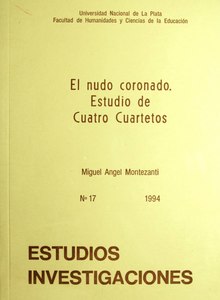
Miguel Angel Montezanti El nudo coronado. Estudio de Cuatro cuartetos; 1994

Reviews were favourable for each poem. The completed set received divided reviews in the United States while it was received overall favourably by the British. The American critics liked the poetry but many did not appreciate the religious content of the work or that Eliot abandoned philosophical aspects of his earlier poetry. The British response was connected to Eliot's nationalistic spirit, and the work was received as a series of poems intended to help the nation during difficult times.[43] Santwana Haldar went so far as to assert that the "Four Quartets has been universally appreciated as the crown of Eliot's achievement in religious poetry, one that appeals to all including those who do not share Orthodox Christian creed."[44]

George Orwell believed just the opposite. He argued: "It is clear that something has departed, some kind of current has been switched off, the later verse does not contain the earlier, even if it is claimed as an improvement upon it [...] He does not really feel his faith, but merely assents to it for complex reasons. It does not in itself give him any fresh literary impulse."[45] Years later, Russell Kirk wrote, "I cannot agree with Orwell that Eliot gave no more than a melancholy assent to doctrines now quite unbelievable. Over the past quarter of a century, most serious critics—whether or not they find Christian faith impossible—have found in the Quartets the greatest twentieth-century achievements in the poetry of philosophy and religion."[46] Like Orwell, Stead also noticed a difference between the Four Quartets and Eliot's earlier poetry, but he disagreed with Orwell's conclusion: "Four Quartets is an attempt to bring into a more exact balance the will and the creative imagination; it attempts to harness the creative imagination which in all Eliot's earlier poetry ran its own course, edited but not consciously directed. The achievement is of a high order, but the best qualities of Four Quartets are inevitably different from those of The Waste Land.[47]

Early American reviewers were divided on discussing the theological aspects of the Four QuartetsF. R. Leavis, in Scrutiny (Summer 1942), analysed the first three poems and discussed how the verse "makes its explorations into the concrete realities of experience below the conceptual currency" instead of their Christian themes.[48] Muriel Bradbrook, in Theology (March 1943), did the opposite of F. R. Leavis and emphasised how Eliot captured Christian experience in general and how it relates to literature. D. W. Harding, in the Spring 1943 issue of Scrutiny, discussed the Pentecostal image but would not discuss how it would relate to Eliot's Christianity. Although he appreciated Eliot's work, Paul Goodman believed that the despair found within the poem meant that Eliot could not be a Christian poet. John Fletcher felt that Eliot's understanding of salvation could not help the real world whereas Louis Untermeyer believed that not everyone would understand the poems.[49]

Many critics have emphasised the importance of the religious themes in the poem. Vincent Buckley stated that the Four Quartets "presuppose certain values as necessary for their very structure as poems yet devote that structure to questioning their meaning and relevance. The whole work is, in fact, the most authentic example I know in modern poetry of a satisfying religio-poetic meditation. We sense throughout it is not merely a building-up of an intricate poetic form on the foundation of experiences already over and done with, but a constant energy, an ever-present activity, of thinking and feeling."[50] In his analysis of approaches regarding apocalypse and religious in British poetry, M. H. Abrams claimed, "Even after a quarter-century, T. S. Eliot's Four Quartets has not lost its status as a strikingly 'modern' poem; its evolving meditations, however, merely play complex variations upon the design and motifs of Romantic representation of the poets educational progress."[51]

Late 20th century and early 21st century critics continued the religious emphasis. Craig Raine pointed out: "Undeniably, Four Quartets has its faults—for instance, the elementary tautology of 'anxious worried women' in section I of The Dry Salvages. But the passages documenting in undeniable detail 'the moment in and out of time' are the most successful attempts at the mystical in poetry since Wordsworth's spots of time in The Prelude—themselves a refiguration of the mystical."[52] Michael Bell argued for the universality within the poems' religious dimension and claimed that the poems "were genuinely of their time in that, while speaking of religious faith, they did not assume it in the reader."[53] John Cooper, in regard to the poem's place within the historical context of World War II, described the aspects of the series appeal: "Four Quartets spoke about the spirit in the midst of this new crisis and, not surprisingly, there were many readers who would not only allow the poem to carry them with it, but who also hungered for it."[54]

In a more secular appreciation, one of Eliot's biographers, the critic Peter Ackroyd, has stated that "the most striking characteristic of The Four Quartets is the way in which these sequences are very carefully structured. They echo and re-echo each other, and one sequence in each poem, as it were, echoes its companion sequence in the next poem. . . The Four Quartets are poems about a nation and about a culture which is very severely under threat, and in a sense, you could describe The Four Quartets as a poem of memory, but not the memory of one individual but the memory of a whole civilization."[55]

In a 2019 interview, conservative philosopher Roger Scruton stated that "...(T. S. Eliot influenced) my vision of culture. And that’s from school days: I came across Four Quartets aged 16 and that made sense of everything for the first time."[56] American author Ross Douthat writes of the poem: "This is a poetic counterpart to Chesterton's prose. Eliot's verse makes no argument, but distills the religious impulse and his own Christian hope to eloquent perfection."[57]

See also

References

Endnotes
  1. ^ Orwell, George, 1903-1950. (2008). All art is propaganda : critical essays. Packer, George, 1960- (1st ed.). Orlando: Harcourt. ISBN 9780151013555OCLC 214322739.
  2. ^ Ackroyd 1984 p. 228
  3. ^ Grant 1997 p. 37
  4. Jump up to:a b c Ackroyd 1984 pp. 254–255
  5. ^ Pinion 1986 p. 48
  6. ^ Ackroyd 1984 pp. 262–266
  7. Jump up to:a b Ackroyd 1984 p. 262
  8. Jump up to:a b Pinion 1986 p. 219.
  9. ^ Gardner 1978 qtd. p. 26
  10. ^ Kirk 2008 p. 239
  11. ^ Kirk 2008 p. 266
  12. ^ Moody 2006 p. 143
  13. ^ Bergonzi 1972 pp. 150–154
  14. ^ Bergonzi 1972 pp. 172
  15. ^ Ackroyd 1984 p. 270
  16. Jump up to:a b Bergonzi 1972 p. 164
  17. ^ Stead 1969 p. 171
  18. ^ Bergonzi 1972 p. 165
  19. ^ Diels, Hermann; Burnet, John Translator. "Heraclitus 139 Fragments" (PDF) (in Greek and English). {{cite web}}|author2= has generic name (help)
  20. ^ Ackroyd 1984 pp. 228–230
  21. ^ Kirk 2008 pp. 246–247
  22. ^ Kirk 2008 pp. 250–252
  23. ^ Kirk 2008 pp. 254–255
  24. ^ Ackroyd 1984 pp. 263–266
  25. ^ Kirk 2008 pp. 260–263
  26. Jump up to:a b Ackroyd 1984 p. 271
  27. ^ Bergonzi 1972 pp. 166–7
  28. ^ Pinion 1986 p. 227
  29. ^ Bergonzi 1972 qtd. p. 168
  30. ^ Bergonzi qtd. 1972 pp. 168–169
  31. ^ Gordon 2000 p. 341
  32. ^ Manganiello 1989 pp. 115–119
  33. ^ Gordon, Lyndall (1 November 2000). T.S Eliot: An Imperfect Life. W.W. Norton and company. p. 369. ISBN 978-0-393-32093-0.
  34. ^ Moody 2006 pp. 143–144
  35. ^ Ackroyd 1984 pp. 265–266
  36. ^ Manganiello 1989 p. 150
  37. ^ Manganiello 1989 pp. 150–152
  38. ^ Bergonzi 1972 pp. 171–173
  39. ^ Kirk 2008 qtd. pp. 241–243
  40. ^ Kirk 2008 p. 244
  41. ^ Pinion 1986 pp. 226–227
  42. ^ Gordon 2000 p. 85
  43. ^ Ackroyd 1984 pp. 262–269
  44. ^ Haldar 2005 p. 94
  45. ^ Kirk 2008 qtd p. 240
  46. ^ Kirk 2008 p. 240
  47. ^ Stead 1969 p. 176
  48. ^ Grant 1997 qtd. p. 44
  49. ^ Grant 1997 pp. 44–46
  50. ^ Kirk 2008 qtd. pp. 240–241
  51. ^ Abrams 1973 p. 319
  52. ^ Raine 2006 p. 113
  53. ^ Bell 1997 p. 124
  54. ^ Cooper 2008 p. 23
  55. ^ T.S. Eliot. Voices and Visions Series. New York Center of Visual History: PBS, 1988.[1]
  56. ^ "The Roger Scruton interview: the full transcript"New Statesman. 26 April 2019. Retrieved 9 April 2021.
  57. ^ Douthat, Ross (15 April 2018). "Ross Douthat's 6 favorite books on religion"The Week. Retrieved 9 April 2021.
Bibliography
  • Abrams, Meyer Howard. Natural Supernaturalism: Traditional Revolution in Romantic Literature. W.W Norton and Company, 1973. ISBN 0-393-00609-3
  • Ackroyd, PeterT. S. Eliot: A Life. New York: Simon and Schuster, 1984. ISBN 0-671-53043-7
  • Bell, Michael. Literature, Modernism, and Myth Belief and Responsibility in the Twentieth Century. Cambridge: Cambridge University Press, 1997. ISBN 0-585-00052-2
  • Bergonzi, Bernard. T. S. Eliot. New York: Macmillan Company, 1972. OCLC 262820
  • Cooper, John. T. S. Eliot and the ideology of Four Quartets. Cambridge: Cambridge University Press, 2008. ISBN 978-0-521-06091-2
  • Gallup, Donald. T. S. Eliot: A Bibliography (A Revised and Extended Edition). New York: Harcourt, Brace & World, 1969. OCLC 98808
  • Gardner, HelenThe Composition of "Four Quartets". New York: Oxford University Press, 1978. ISBN 0-19-519989-8
  • Gordon, LyndallT. S. Eliot: An Imperfect Life. New York: W. W. Norton & Company, 2000. ISBN 0-393-04728-8
  • Grant, Michael, T. S. Eliot: The Critical Heritage. New York: Routledge, 1997. ISBN 0-7100-9224-5
  • Haldar, Santwana. T. S. Eliot : A Twenty-first Century View. New Delhi: Atlantic Publishers & Distributors, 2005. ISBN 81-269-0414-3
  • Howard, Thomas. Dove Descending: A Journey Into T.S. Eliot's Four Quartets. Ignatius Press, 2006. ISBN 1-58617-040-6
  • Kirk, RussellEliot and His Age: T.S. Eliot's Moral Imagination in the Twentieth Century. Wilmington: ISI Books, 2008. OCLC 80106144
  • Manganiello, Dominic. T. S. Eliot and Dante. New York: St. Martin's Press, 1989. ISBN 0-312-02104-6
  • Moody, A. David. "Four Quartets: Music, Word, Meaning and Value" in The Cambridge Companion to T. S. Eliot, ed. A. David Moody, 142–157. Cambridge: Cambridge University Press, 2006. ISBN 0-521-42080-6
  • Newman, Barbara. "Eliot's Affirmative Way: Julian of Norwich, Charles Williams, and Little Gidding." Modern Philology 108 (2011): 427–61. doi:10.1086/658355 JSTOR 10.1086/658355
  • Oser, Lee. "Coming to Terms with Four Quartets." Blackwell Companion to T. S. Eliot. Ed. David Chinitz. Oxford: Wiley-Blackwell, 2009: 216-227. doi:10.1002/9781444315738
  • Pinion, F. B. A T. S. Eliot Companion. London: MacMillan, 1986. OCLC 246986356
  • Raine, Craig. T. S. Eliot. Oxford: Oxford University Press, 2006.
  • Stead, Christian. The New Poetic: Yeats to Eliot. Harmondsworth: Pelican Books, 1969. OCLC 312358328