* * * * * * * * * * *
April 11, 2009
FAIRBANKS, Alaska — Before his death in 1998, the English poet Ted Hughes published a searing volume about his life with Sylvia Plath called “Birthday Letters.” The poems, almost all addressed to Ms. Plath, explored the beauty and then fracturing of their marriage before her suicide in 1963.
One poem, though, was written to their children, Frieda and Nicholas. Titled “The Dogs Are Eating Your Mother,” it warned of ravenous Plath devotees who “will find you every bit as succulent,” and it offered a kind of blessing to Nicholas, who had long kept the literati at bay:
So leave her.
Let her be their spoils. Go wrap
Your head in the snowy rivers
of the Brooks Range.
The lines were a succinct rendering of Nicholas Hughes, a man who joyously devoted his career to the study of fish in Alaska’s snowy rivers and whose home, a handsome 2,800-square-foot cabin on 20 pristine acres of spruce and birch, faced toward the distant Brooks Range. He was a man who made it clear to friends that he would rather discuss the finer points of ice fishing than the writings of his parents. Indeed, some of his colleagues in the School of Fisheries and Ocean Sciences at the University of Alaska, Fairbanks, worked with him for years without knowing he was the son of two major 20th-century poets.
All that changed on March 16.
It was sunny, the temperature hovering just below zero, and Mr. Hughes seemed in good spirits. For years he had battled depression, as his mother had, and on a recent trip to New Zealand he had even talked of suicide. But he had endured other low periods, leaning on close friends, getting medical help and managing his illness with exercise and regular winter migrations to New Zealand’s sunnier climes. At his cabin that afternoon, he drank tea with his girlfriend, Christine M. Hunter.
“It’s a good day,” he told her. He said he was going to go for a walk. Ms. Hunter, a wildlife ecology professor at the university, went upstairs to grade papers. Around 4 p.m., when he had not returned, Ms. Hunter went searching. Mr. Hughes had told friends that if he was ever going to take his life, he had decided the best method was to hang himself in his workshop by his cabin. Ms. Hunter found him there, hanging by a thin nylon cord tied to an exposed ceiling beam.
Mr. Hughes, 47, did not leave a note. Investigators, though, said it was clear from the evidence that he had planned his death carefully. “He knew what he was doing,” State Trooper Michael Wery said.
In the weeks since, the news of the suicide has cut through two distant and disconnected worlds in vastly different ways.
In the thriving community of Plath and Hughes scholars, the death has been deeply felt through the prism of his parents’ writings. His birth was vividly chronicled in Ms. Plath’s journals. He was “the baby in the barn” in “Nick and the Candlestick,” from Ms. Plath’s best-known collection, “Ariel,” written in her final months.
And in the event that looms over every page of “Birthday Letters,” he was little Nick, barely 1, when Ms. Plath carefully sealed him and Frieda in another room and then gassed herself in the oven of her North London flat.
“They almost feel like they know them through the poetry,” said Karen V. Kukil, who curates the Sylvia Plath collection at Smith College. Ms. Kukil said that when she gave talks, people inevitably asked about Nicholas and Frieda. After all, not only did they absorb their mother’s death, but they also endured what came six years later, when Assia Wevill, the woman for whom Mr. Hughes left Ms. Plath, gassed herself and their 4-year-old half sister, Shura.Photo
 |
| Nicholas Hughes | Credit Courtesy of Mark Wipfli |
Audiences, Ms. Kukil said, seemed reassured when she described Nicholas Hughes’s life in remote Alaska, a path in keeping with his father’s love of nature and fishing. His suicide, she said, “really hit people hard.”
In Fairbanks, the responses are more complex. Here a community of scientists knew him not through his parents’ poetry, but through the ingenuity of his research into freshwater ecosystems. They knew him from ice fishing and cycling, from gardening or making pottery. And with his death there is building resentment, a sense that his life and death are being distorted by strangers, depicted as either the inevitable after-effect of his father’s infidelities or somehow genetically foreordained by his mother’s demons.
Their Nicholas Hughes was a man of immense energy and curiosity, most at home in a well-worn wool sweater and a battered pair of Xtratuf boots, marching over tundra toward some hidden bend of water. He was possessed with an utter distaste for academic politics and a special gift for finding simple solutions to complex scientific problems, which he then translated into clear, clean prose for the most important publications in his field.
“For me, his work was elegant and beautiful, just like a good poem,” said Amanda E. Rosenberger, an assistant professor in the School of Fisheries and Ocean Sciences, wiping away tears.
His friends here are grappling with his death not as heart-rending literary coda, but as devastating loss — for his girlfriend, for the students he mentored and for the future of fish ecology. Using elaborate underwater camera systems and sophisticated computer models, Mr. Hughes had developed new ideas about how salmon, grayling and other fish chose their habitats. He had an encyclopedic knowledge of ecosystems, yet he was also an expert in hydrodynamics and evolutionary biology — a kind of academic triple threat.
This is one reason people here scoff at the notion that he came to Alaska as some kind of “Into the Wild” escape. His fascination with fish spans more than two decades, back to Oxford University, where he earned bachelor’s and master’s degrees in zoology, followed by a Ph.D. in biology from the university here in 1991. After winning several prestigious research positions in Canada and Alaska, he was hired as an assistant professor here in 1998. He was 36, and a promotion to associate professor and tenure followed in due course.
Mr. Hughes worked in a cluster of research buildings atop a ridge overlooking a plain where herds of reindeer graze. It is an informal setting, where scientists keep cross-country skis in their laboratories so they can go skiing at lunchtime. The life suited him, both professionally and because of his love for the Alaskan wilderness. As much as he liked observing fish, he also loved to catch them, especially the homely but tasty burbot.
“He was fully engaged in the Alaska experience,” said Denis A. Wiesenburg, dean of the School of Fisheries and Ocean Sciences.
But he also appreciated another quality of Alaska — the shared reverence for being left alone. Several of his friends politely refused interview requests, saying they simply did not believe that Mr. Hughes would want any intrusion into his privacy. Likewise, those who knew of his family story considered it basic good manners not to trespass on the subject uninvited.
 |
Some of Nicholas Hughes’s colleagues went years without knowing
that he was the son of the poets Ted Hughes and Sylvia Plath,
above. | Credit Agence France-Presse, Associated Press |
Frank Soos, a retired English professor, was in a cycling group with Mr. Hughes, and he knew the work of Sylvia Plath and Ted Hughes well. But not once did he broach the subject. “It was so apparent he didn’t want to go there,” Mr. Soos said. In fact, he recalled, their relationship changed when Mr. Hughes learned he taught English.
“You could feel a palpable distance creep in there,” he said.
Carin Bailey Stephens, a public information officer at the university, had studied poetry and knew about his parents through the grapevine. “I hear you are the son of Sylvia Plath,” she recalled telling him, hoping for a conversation about writing.
“He just immediately made it clear that he knew about science and he wasn’t interested in writing,” she said. “He was very gentle about it.”
His colleagues knew of his struggle with depression, but they also said he worked hard to manage it. Still, in September 2006 his bosses grew alarmed when he did not show up for work for several days. Eventually the state police were asked to check up on him.
A few months later he abruptly resigned his university position. Friends said he wanted to escape the stresses of academic politics and administrative drudge work. But thanks to his mother’s literary estate, he could afford to pursue his research on his own, and he continued work with another professor, Mark S. Wipfli, on a major project studying the demographics and ecology of Chinook salmon in the Chena River.
He also bought his cabin on the outskirts of Fairbanks, and he began dating Ms. Hunter, whose own research has helped describe how global warmingis threatening polar bears. Ms. Rosenberger joined the couple for dinner in December, just before they left for New Zealand. “I was glad to see he was in a relationship and happy,” she said.
But Trooper Wery said Ms. Hunter told investigators that Mr. Hughes had become distressed about one particular subject — discord between his sister and their stepmother, Carol Hughes. The two women have quarreled in recent years over the estate of Ted Hughes. Neither Ms. Hunter nor Frieda Hughes, herself a poet, painter and author in England, responded to requests for comment.
On March 30, friends gathered in a conference room at the university for a memorial service. Colleagues from Juneau and New Zealand were patched in by video. Plans were hatched to establish the Nick Hughes Memorial Scholarship Fund at the university. Although his death generated headlines around the world, his memorial service went unmentioned in the next morning’s Daily News-Miner.
Not that the newspaper did not know about it. Dermot Cole, the newspaper’s main columnist, said he had known for at least a decade that the son of Sylvia Plath and Ted Hughes lived in town. Every so often he would call and try to persuade Mr. Hughes to let him write about him. “He just didn’t want to do it,” Mr. Cole said. After the suicide, he wrote Mr. Hughes’s obituary, but he said it simply did not feel right to intrude on the memorial service.
Mr. Cole said he wanted to give him his privacy.
* * * * * * * * * * *
 |
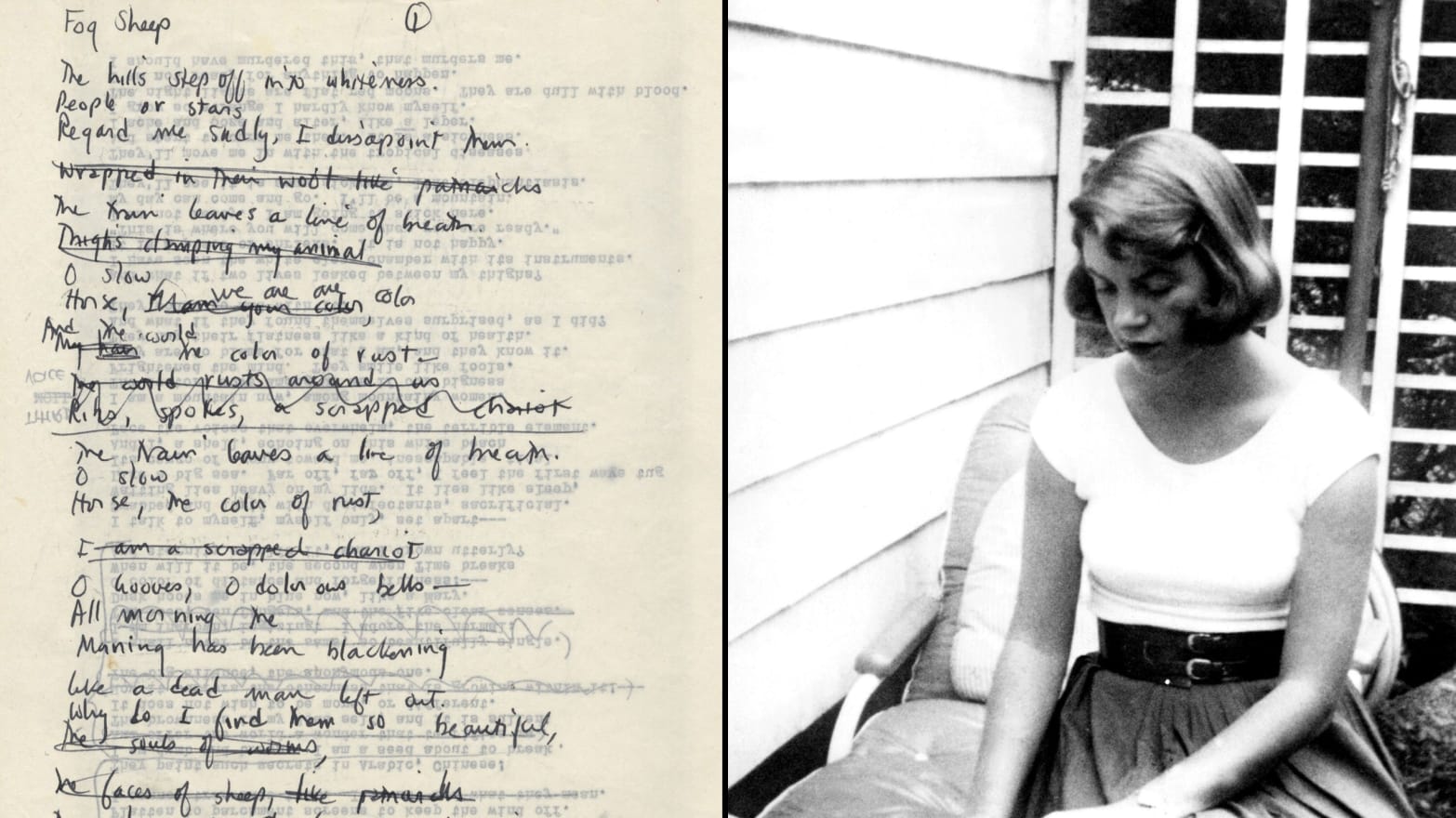
| Sylvia Plath, 1954 | Credit Everett Collection, via Alamy |
Sylvia Plath’s Last Letters Show Her Struggling
to Imagine Life Without Ted Hughes
by Katie Roiphe
Nov. 8, 2018
THE LETTERS OF SYLVIA PLATH
Volume 2: 1956-1963
Edited by Peter K. Steinberg and Karen V. Kukil
Illustrated. 1,025 pp. HarperCollins Publishers. $45.
One could certainly be forgiven for thinking that no remaining bit of Sylvia Plath scholarship could change one’s view of the much analyzed poet. However, the adroitly edited new collection of her letters, “The Letters of Sylvia Plath, Volume 2: 1956-1963,” which spans her entire marriage to the English poet Ted Hughes and its aftermath, and includes many letters that had not previously been published, provides one of the most vivid and intimate accounts of her life to date.
In particular, these letters vastly enrich our understanding of Plath’s state of mind leading up to her suicide, which has been patchy and sparse, in part because of Hughes’s decision to destroy her final journal. “The Unabridged Journals of Sylvia Plath” ends in early July 1962, right before the ultimate crisis in their marriage, so the new collection of letters offers a fresh look at her struggle with Hughes and the last wild months of her life.
One striking aspect of these letters is how prominently and enthusiastically the domestic details of Plath’s life in England, like stew recipes or flaky crusts or home-sewn baby clothes, are discussed, even as she remains intensely dedicated to her work. She is invested in a vision of a domestic bohemian idyll with more than the usual amount of urgency. She seems to feel that this fantasy household is almost within her reach if only she could have Toll House chocolate morsels, or paint the floors, or get a sewing machine, or learn how to make her own mayonnaise. There is something feverish in this pursuit of perfection; Plath is obsessive, driven — ambitious, almost — toward domestic happiness. For nearly 800 pages, she is basically silent on any conflict with Hughes, but after hundreds of letters delineating domestic improvements and yearnings, one begins to suspect that there is a bigger problem in her house that she is trying to fix, a more profound anxiety she is trying to quiet.
 |
| Plath with her mother and two children in Devon, England, 1962 | Credit CSU Archive/Everett, via Alamy |
The most substantive revelations here, however, are the letters she wrote in the last eight months of her life to an American psychiatrist, Dr. Ruth Beuscher. She began her treatment with Beuscher in 1953, after the early suicide attempt chronicled in her novel “The Bell Jar,” and saw her again five years later, when Plath and Hughes had temporarily decamped to America. The poet remained close to Beuscher until the end of her life. These desperate letters, which until recently were privately held, provide astonishing insight into Plath’s inner state in the troubled months when she wrote her strongest poems.
These letters are more intimate, more raw, than the rest of her correspondence. To other people, even her mother, with whom she had an extremely close if tortured relationship, she carefully curates herself. In her letters to Beuscher, there is a kind of frantic rush of honesty, a thought process laid bare, a concerted effort to sort through and analyze her feelings. While she is writing to other people about doll prams or pork sandwiches, she is confiding in Beuscher about Hughes disappearing after a romantic night at an expensive hotel, or frankly describing the precise tenor of their sexual relations.
Without much comment, she briefly mentions a disturbing incident in which Hughes “beat me up physically” in the days before a miscarriage. She says that at the time she felt this was an “aberration” that she had provoked by deliberately ripping a manuscript of his.
 Plath apparently wanted to view these letters as therapeutic “sessions” and offered to pay Beuscher to read and respond to them, but the psychiatrist refused payment and wrote back to her anyway. In confiding in Beuscher, after discovering her husband’s affair with Assia Wevill, Plath seems to be trying to solve the problem of herself. How can she change to make the marriage work? She writes: “How can I make these women unnecessary to him? And keep up my own sense of seductiveness and womanly power? I don’t want to be sorrowful or bitter, men hate that, but what can I do in the face of these prospects?” She also writes: “Can you suggest a gracious procedure when you see some little (whoops, not little, big!) tart is after your husband at a party, or dinner or something? Do you leave them to it? Engage a hotel room? Smile & vanish? Smile & stand by? What I don’t want to be is stern & disapproving or teary. But I am only human. I have to feel I have some ground-rights.”
This is very far from the familiar cold rage of the late poems: “Out of the ash / I rise with my red hair / And I eat men like air.” The Plath of these letters is engaged in a painful struggle to make her marriage work, and, later, to finding her way to managing on her own. She reveals herself as hurt and humiliated and devastated in characteristically electric prose: “He told me the truth about the femme fatale, which freed my knowledge to sit about in the light of day, like an object, to be coped with, not hid like some hair monster. And I didn’t die.”
The letters to Beuscher are moving and revelatory because they add a dimension to the hard, brilliant, glittering fury of the late poems. We are familiar with Plath’s fierceness, the power of her imagination to exact revenge, to correct humiliations, to create dark drama out of despair. But we are notably less familiar with the Plath of these letters, trying so hard to steady herself, to gain perspective, to find her way toward the independence and health she could so clearly make out, just in the distance.
The decline of her marriage and her subsequent breakdown have been subject to so much projection and politicizing that it is an enormous contribution to see the poet tackle these events in her own words. These letters take the grand archetype of suicidal Plath, the elaborate, brittle mythologies that have sprung up around her, and give them an unforgettable human specificity. What has been missing from the biographical record of the final months is Plath’s own voice.
The saddest thing to watch is how hard she was working to get better. Beuscher advised her not to imagine that she couldn’t exist without Hughes: “First, middle and last, do not give up your personal one-ness.” She warns her not to imagine that her entire life hinges on one particular man. Plath was trying to make her way to the doctor’s words. “The part about keeping my personal one-ness is a real help. I must. But my god I can’t see to thinking straight.”
What comes across so clearly and heartbreakingly in these letters is how hard she is trying. She is actively engaged in the intellectual work of getting better. Beuscher recommends Erich Fromm to her, and she reads and stars a passage: “I have finally read the Fromm & think that I have been guilty of what he calls ‘Idolatrous love,’ that I lost myself in Ted instead of finding myself.”
She wanted so badly to be able to see a life without Hughes, to be able to inhabit it. She could almost see it. She writes to Beuscher, “If I could study, read, enjoy people on my own, Ted’s leaving would be hard, but manageable.” Seven days later, she was dead.
____
*Katie Roiphe is the author of “The Violet Hour: Great Writers at the End,” and the director of the cultural reporting and criticism program at New York University.
*A version of this article appears in print on Nov. 11, 2018, on Page 39 of the Sunday Book Review with the headline: Mad Girl’s Love Song.
* * * * * * * * * * *