"Autobiographies of great nations are written in three manuscripts – a book of deeds, a book of words, and a book of art. Of the three, I would choose the latter as truest testimony." - Sir Kenneth Smith, Great Civilisations

"I must write each day without fail, not so much for the success of the work, as in order not to get out of my routine." - Leo Tolstoy

I have never believed that one should wait until one is inspired because I think the pleasures of not writing are so great that if you ever start indulging them you will never write again. - John Updike

"The life of every man is a diary in which he means to write one story, and writes another; and his humblest hour is when he compares the volume as it is with what he vowed to make it." - J.M. Barrie, Peter Pan

Poetry is the shadow cast by our streetlight imaginations." - Lawrence Ferlinghetti


[Note - If any article requires updating or correction please notate this in the comment section. Thank you. - res]


Friday, March 6, 2026

R.E. Slater - The Processual Lessons of "Frankenstein"


Illustration by R.E. Slater and ChatGPT

Creation, Responsibility, and Relational Life

A Process-Oriented Reading of Frankenstein

By Mary Shelley (1818). Reconsidered through a relational-process lens

by R.E. Slater & ChatGPT

“Nothing in the universe exists in isolation.
Every action begins a chain of consequences.
We live within societies of relationships.”
- R.E. Slater

“Learn from me, if not by my precepts,  at least by my example -
how dangerous is the acquirement of knowledge.”
- Mary Shelley, Frankenstein


Introduction

When Frankenstein appeared in 1818, its readers encountered something far more profound than a gothic tale of horror. Written by Mary Shelley during a Victorian period of rapid scientific curiosity and philosophical upheaval, the novel probes questions that still confront modern society:

What responsibilities accompany knowledge?
What obligations do creators bear toward their creations?
And how does neglect distort the moral character of both individuals and communities?

The novel’s enduring power lies in its exploration of relational consequences. Every action generates further effects within a society of lives, emotions, and expectations. Victor Frankenstein’s experiment is not merely a scientific misstep; it is a rupture in the web of human responsibility. His refusal to nurture what he has brought into existence triggers a cascade of suffering that spreads through families, friendships, and even the natural world.

Viewed through a process-oriented perspective, Frankenstein reads less as a monster story and more as a meditation on relational formation, moral emergence, and the responsibility to shape power and community. Characters do not appear fully formed. Rather, their identities unfold through interactions, decisions, and responses to the environments they inhabit.

The themes of the novel illustrate how life unfolds through dynamic participation rather than static identity. Each theme reveals the next stage in character formation and moral direction develop through evolving relationships, recognition, and responsibility.


Illustration by R.E. Slater and ChatGPT

I. Ambition Without Moral Orientation

Victor Frankenstein embodies the danger of knowledge detached from ethical reflection. His desire to unlock the secret of life drives him into obsessive isolation. The laboratory becomes a symbolic chamber of intellectual pride, where discovery is pursued for glory rather than wisdom, and the hubris of "playing God" is enacted.

The tragedy of Victor’s experiment lies not in the discovery itself but in its disconnection from responsibility. He achieves a remarkable scientific breakthrough yet refuses to care for the life he has animated. Knowledge is treated as an achievement rather than a creational trust.

Processual Illustration

From a relational perspective, knowledge is not an isolated possession but a participatory act within a wider field of consequences. Every new capability reshapes the environment in which it appears. Victor’s failure is not scientific curiosity; it is the refusal to acknowledge the relational obligations generated by that curiosity.

In this sense, the novel anticipates modern ethical questions surrounding artificial intelligence, biotechnology, and environmental manipulation. Innovation always creates new relationships but each one will require nurturing stewardship.


II. Creator and Creation

One of the most striking elements of Frankenstein is the moral relationship between creator and created being. Victor animates the Creature but instantly recoils from him, immediately abandoning what he has brought into existence.

The Creature begins as a sensitive observer of the world. He learns language, studies human behavior, and longs for companionship. His earliest impulses reveal empathy and curiosity rather than cruelty.

It is only later, his violence emerges not from inherent wickedness but from prolonged rejection.

The question Shelly asks are several:

What obligations do creators have toward what they create?
Can abandonment produce monstrosity?

Processual Illustration

Identity arises through interaction. The Creature’s character develops through the responses he receives from the world around him.

Where compassion appears, kindness grows.
Where hostility dominates, resentment deepens.

Shelley’s narrative quietly suggests that moral character is not fixed at birth. It evolves through recognition, dialogue, and belonging within a community of relations.


III. Isolation and the Collapse of Human Flourishing

Isolation appears repeatedly throughout the novel.

Victor withdraws from his family during his obsessive research. The Creature wanders through forests and villages unable to form relationships. Captain Walton, writing letters from the icy reaches of the Arctic, longs for intellectual companionship.

Each figure represents a different form of loneliness.

The novel suggests that prolonged isolation erodes psychological stability. Without the corrective presence of others, individuals lose moral perspective.

Processual Illustration

It is not a mere observation to state that "Human life unfolds within networks of participation." When individuals sever themselves from these networks, their inner worlds distort. Empathy diminishes, imagination becomes narrow, and judgment weakens.

Shelley portrays community not merely as social convenience but as a stabilizing field in which character and moral awareness are cultivated.


IV. Nature as Restorative Presence

Whenever Victor approaches emotional collapse, he turns toward nature. The mountains, glaciers, forests, and glens, provide temporary relief from the turmoil within him.

Nature in the novel represents balance. It stands as a quiet counterweight to Victor’s manipulative ambitions.

The Romantic worldview, which shaped Shelley’s writing, regarded nature as a teacher capable of restoring moral clarity.

Processual Illustration

Nature can indeed function as a harmonizing environment within the human breast where human awareness can delicately recalibrate itself. When Victor immerses himself in the landscape of nature, he experiences moments of renewed clarity and perspective.

The natural world reminds him that life is not merely a collection of objects to be manipulated but a living network of fragile relationships unfolding across time.


V. Appearance and Moral Misjudgment

One of the novel’s most tragic dynamics arises from the way humans judge the Creature solely by his appearance. Many of history's life clearest lessons resonate with Shelley's poignant observation.

But despite the Creature's articulate speech and thoughtful reflections, he is rejected immediately out-of-hand by every person he encounters on the mean premise of looks and sound.

Shelley challenges the assumption that outward form reveals inner character. The Creature’s physical form provokes fear, but his inner life reveals sensitivity and longing.

Processual Illustration

Social perception shapes identity. When individuals are consistently treated as monsters, they may eventually internalize the roles assigned to themselves. We see this testament too often around us.

Moreover, Shelley shows how social interpretation participates in the formation of personal identity. Communities help shape the trajectories of those they accept or reject.


VI. The Search for Identity

The Creature’s most profound struggle is existential. He seeks answers to questions that define human self-awareness:

Why was I created?
What is my place among living beings?
Is there anyone like me?

Through books he discovers philosophy, history, and poetry. These texts awaken his awareness of injustice and human suffering. Yet they also deepen his loneliness.

Processual Illustration

Selfhood develops through narrative understanding. As the Creature interprets the world around him, he constructs a sense of identity shaped by observation and reflection. This is not only true of individuals but of societies as well when refusing to reach out, love, and nurture.

Without belonging or companionship, the relational process becomes fractured. Identity cannot flourish without relational grounding.


Mary Shelley's Frankenstein

VII. Responsibility and Consequences

The tragic deaths in the novel ultimately trace back to Victor’s initial abandonment of the Creature.

Each loss represents the widening ripple of neglected responsibility. What begins as a single act of rejection expands into multiple layers of suffering.

Shelley’s narrative illustrates how moral negligence rarely remains contained. It spreads outward through families, communities, and generations.

Processual Illustration

Every decision contributes to the shaping of future possibilities. Neglectful or helping actions can alter the relational environment within which later choices and influences occur.

Victor’s refusal to acknowledge responsibility destabilizes the entire web of relationships surrounding him.

The story reveals how ethical responsibility is inseparable from participation in shared life.


Conclusion

Frankenstein remains powerful because it addresses questions that persist in every generation. Scientific discovery, creative power, and technological innovation continually expand humanity’s ability to reshape the world.

Shelley reminds us that such power cannot exist apart from responsibility.

Her novel portrays life not as a collection of isolated individuals but as a living tapestry of relationships:

Character, identity, and moral direction arise through nurturing participation in communities of care, recognition, and accountability.

Victor Frankenstein’s tragedy lies not in his brilliance but in his refusal to nurture the life he created. By turning away from responsibility, he fractures the relational bonds that sustain human flourishing.

The lesson of Frankenstein is therefore not a rejection of knowledge but a call for wisdom within knowledge.

Discovery must remain connected to empathy, stewardship, and relational awareness.

Only within such a framework can human creativity contribute to the flourishing of life rather than to its unraveling.


CrossRoads
by R.E. Slater

A spark brightly struck -
new life stirred within the shadows,
yet no hand remained
to nurture its fragile steps.

It grew. It became.
The lonely mind
wandered a winter of forests
seeking a guiding voice
that unanswered its own.

Creational care is a must -
without, a silent wilderness
gathers up mounting sorrows
within the nexus of lonely hearts.


R.E. Slater
March 6, 2026
@copyright R.E. Slater Publications
all rights reserved


Thursday, March 5, 2026

R.E. Slater - A Conversation Before Leaving: A Processual Essay on Becoming


Illustration by R.E. Slater and ChatGPT

A Conversation Before Leaving
A Processual Essay on Becoming

by R.E. Slater

“We are not the same person we were yesterday,
nor will we be tomorrow.”
Heraclitus
I

His friends from university were scholars and were gathering together that afternoon because he was leaving. Not retiring. Leaving.

As they arrived by ones and twos, no one could quite explain why the gathering felt heavier than a simple retirement, or a prolonged sabbatical, or like one of those quiet academic disappearances which happen each year.

People just leave. College offices get reassigned. New names are hung outside. Academic books remain on their shelves like fossils of remembrance.

Still, this felt different.

Inside the small cabin its owner, John, a historian by trade, stood near the latticed window, sunlight bending across the wooden floorboards. Packing boxes lay scattered around the room - some were far too light, as if their owner had learned not to carry too much, hold too much, or burden himself with unnecessary things.

“You could at least tell us where you’re going,” said Sandy, John's girlfriend, half-smiling.

“I could,” John replied from across the room, “but it wouldn’t help,” in slight foreshadowing.

Light laughter followed among his gathering friends. More sympathetic than amused... yet something in the room had begun to shift.

More like a liminal interior light that wanted switching on, but at that moment, couldn't. And then, there followed a small suggestion. Half wise-ass, half-serious. Begun, at first, as a joke....

II

“What if,” said John, turning thoughtfully from the window, “a man never aged?”

A few stray chuckles echoed through the empty cabin walls. To the group, John's query felt personal. Something he had never betrayed before.

“Is this a thought experiment?” asked Dan, a field anthropologist.

“If you like.”

Harry leaned eagerly forward preparing for debate, “Then how long are we talking?” 

John paused, not theatrically, but as if choosing the smallest of honest answers.

“Say, fourteen thousand years.”

Silence did not fall. It filled the room, breathlessly. A perfect beginning... and the first of several small fractures beginning to form within their final reunion.

III

“No,” responded Dan immediately to the statement. “It's biologically impossible.”

“Of course,” John nodded. “That’s always the first response.”

"But say the body repairs itself. It refuses to die. It just lives on."

"Still impossible!" said Harry. "Again, biologically incongruent with what we know about the human body."

Unwilling to let the conversation end Dan folded his arms and mulled half to himself, “Fourteen thousand years ago we were still shaping flint tools. Anthropology leaves very little room for wandering immortals.”

Harry shook his head in quiet contemplation. “Cells deteriorate. DNA accumulates damage. Biology is not generous with time.”

“Is there a second response?” Sandy quizzically asked, keeping the discussion moving.

John smiled, faintly, but tenderly.

“Sometimes.”

His friends circled him now - not physically, but intellectually. They took the bait. Their questions sharpened. Old professions rose up donning familiar armor. Amongst the occupants was an anthropologist, a biologist, a Christian theologian, a psychologist, a historian, an archaeologist.

Each voice tried to stabilize the moment as it hungered for hypothetical sparing.

“You’re asking us to suspend everything we know...” asked Dan.

“I’m asking you to imagine it,” John said. “Not to believe it.”

“Why?” Edith asked, settling within, a bit quieter than the rest.

John looked at her differently. Seemingly peering into her wounded being.

“To see what changes.”

IV

“Say it’s true!” Harry finally spoke up. “Then what are you?”

John shrugged.

“A person who kept going. Kept living.”

“That’s not an answer!”

“It’s the only one that makes sense.”

John continued, not in grand declarations, but in fragments:

“Say, I experienced a winter that lasted too long. Spoke a language no one remembers. Remembered a child who died before there were names for grief?”

... Catching his breath, having stopped a moment in reflection, he continued, “I stopped keeping count after a while. Not the years, but the people who came into-and-out-of my life.”

This confused his well-wishers...

“Wait! You’re saying you became different people?”

“No,” John replied. “I’m saying I couldn’t stay the same person,” as the weight of memory began adding up again.

V

Sensing John's internal burden, but not quite sure if he was up to his old parlor games of “What if?” Edith cautiously asked, “What happens when you remember too much?”

John didn’t answer right away. He let it sink into the fellowship's psyche. Let it build. Turn. Begin to grow.

“You forget differently,” he said.

“How then does that make sense?”

“You don’t lose things... they just stop becoming close.”

The room grew still. Somber. Rethinking their responses - and surprisingly - feeling more emotionally drawn in than on other past occasions.

“We think memory keeps us going,” John continued. “But it doesn’t. It changes us. It rearranges what matters in life.”

Sandy quickly remarked, “And you’re not tired? You're not weary?”

John looked at her, even more tenderly than before. He stepped backed and really examined his loving friend whom he was leaving behind.

“I don’t think tired is the right word.”

“Then what is?”

He searched for it. “Full, I think. Stuffed. Like I've ingested too much. Seen too much. Felt too much.” he reflectively said.

VI

At which point the proverbial pot began to come to a boiling point, as they would say.

“Ok, out with it!” Dan snapped. “You’re lying!”

“Probably,” John deferred.

“Or you're delusional!”

“Also quite possible,” continuing to play a game that was becoming all too real.

“Then why continue this charade?”

John tilted his head towards his friends.

“Because you haven’t stopped listening. You're all too willing to play this game with me.”

That landed harder amongst his skeptical friends than anything John had yet offered.

Next, old Will, who had been quiet until now, finally spoke from the corner of the room. As a psychologist he had listened more than he had argued.

“Not necessarily delusional,” he said tentatively. “People sometimes construct elaborate narratives when memory and identity stretch too far apart. The mind prefers a meaningful story to an empty one.”

John studied his friend with interest, as if he remembered him in another setting.

“You think this is therapy?”

Will shrugged.

“I think it's human.”

VII

At this point, there arose a story within a story. One with many outcomes measured in hot feelings and personal outbreaks.

“Have you ever influenced history?” questioned Sandy, evenhandedly, the resident archaeologist who remained more open than the others to her love's hypotheticals.

John hesitated, mulling his response.

“Not in the way you mean.”

“Try us,” she suggested.

He slowly exhaled, not for the first time wishing to bear his soul.

“There was a time,” he added slowly, “when I shared what I had learned - about kindness, about compassion, about letting go of vengeance.”

“Go on.”

“It began to be heard. To be understood, but circumstances resulted which forced me to move on before my words could spread. Years later I heard stories. They had grown.”

Around the room Edith’s voice could be heard trembling; she was collecting up John's strands of thought - putting them together in a way which began to move her.

“What... What are you saying…??”

“I’m saying, stories change when people need them to.”

“That’s not an answer!”

“But it’s the only one I trust,” John kindly reflected.

VIII

The sun had shifted. The room no longer held the same light. But Edith's disturbed response lay heavily in the air. John's story had turned. It was no longer a story, it was a unwanted realization within a nest of growing, unwanted relalizations.

No one had proven anything. No one had disproven anything. And yet, a new gravity was forming. A new reality.

Everything felt altered.

Sandy then spoke, almost reluctantly:

“John, if none of this is true… then why does it matter?”

Absent-mindedly John picked up one of his moving boxes, “Because you are all still asking the question. You're wondering if behind my words there is a new meaning unfelt in our previous relationships.” 

“That’s not enough response!” Art replied sharply. “Clever stories are not factual evidence.  They can be suggestions without basis! Universities are built on proof! Reason! Not imaginative tales!”

“Yes, I think it might be enough,” came John's half-turned reply as he carried out a small box to his awaiting pickup outside allowing his absence to bring the temperature down a notch or two.

IX

But, before leaving, he paused at the door, and asked again, “Think about it, why should we care?”

Not for effect, but as if recognizing something in their discussion was something he had seen before.

“You don’t need fourteen thousand years,” he said.

No one moved.

“Look around you - you’re already changing. Every conversation, every loss, every moment you decide to stay or leave —” as he gestured gently around the room holding his package.

“—this is how it happens.”

Edith spoke almost to herself, not for the first time. “Maybe that’s what life is really doing to us,” she uttered.

Turning back, John paused again at the doorway.

“What?”

She searched for the word but never quite found it.

John smiled faintly and stepped outside.

X

Stepping out onto the cabin's gravel driveway, the door softly closed behind him.

No resolution had followed. No consensus had formed.

Inside, among the remaining scattered boxes and lengthening evening shadows, the small community of scholars were holding quiet vigil.

Some emotion - a sense, a feeling - lingered. Not an agreement; but more like tension. A disturbance.

A  suspicion that identity and meaning might be less solid than they had always assumed.

An awareness that memory continually reshapes us even as we pretend to remain the same.

That meaning is not something handed down intact, but something slowly assembling across the years... something only experienced across time.

Outside, the truck's engine started. John was leaving. Not for the first time.

Inside, beneath the fading conversation of “What If?” a quieter question had formed though no one would say aloud:

“If life keeps changing us... why do we spend so little time noticing?

“Why aren’t we paying attention?

Perhaps learning to hold loosely the unnecessary things so that we might draw closer to the things that really matter?”

To those thoughts came no reply.

Another companion - a dear friend - had just left their lives without saying goodbye.


R.E. Slater
March 7, 2026
@copyright R.E. Slater Publications
all rights reserved


“We imagine life as something we possess,
yet life is something we always possess, as becoming.”
 - R.E. Slater

“Some conversations never end when the speaker in our head leaves -
they remain with us, quietly reshaping what we thought we knew.”
- R.E. Slater

“We rarely notice how much we are changing
until someone asks a question we cannot easily dismiss.”
- R.E. Slater


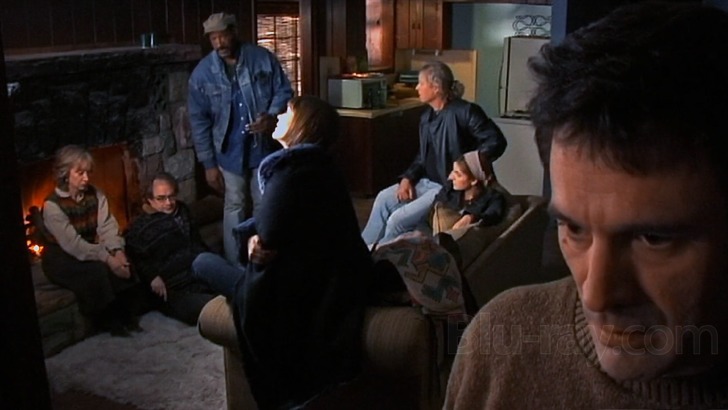
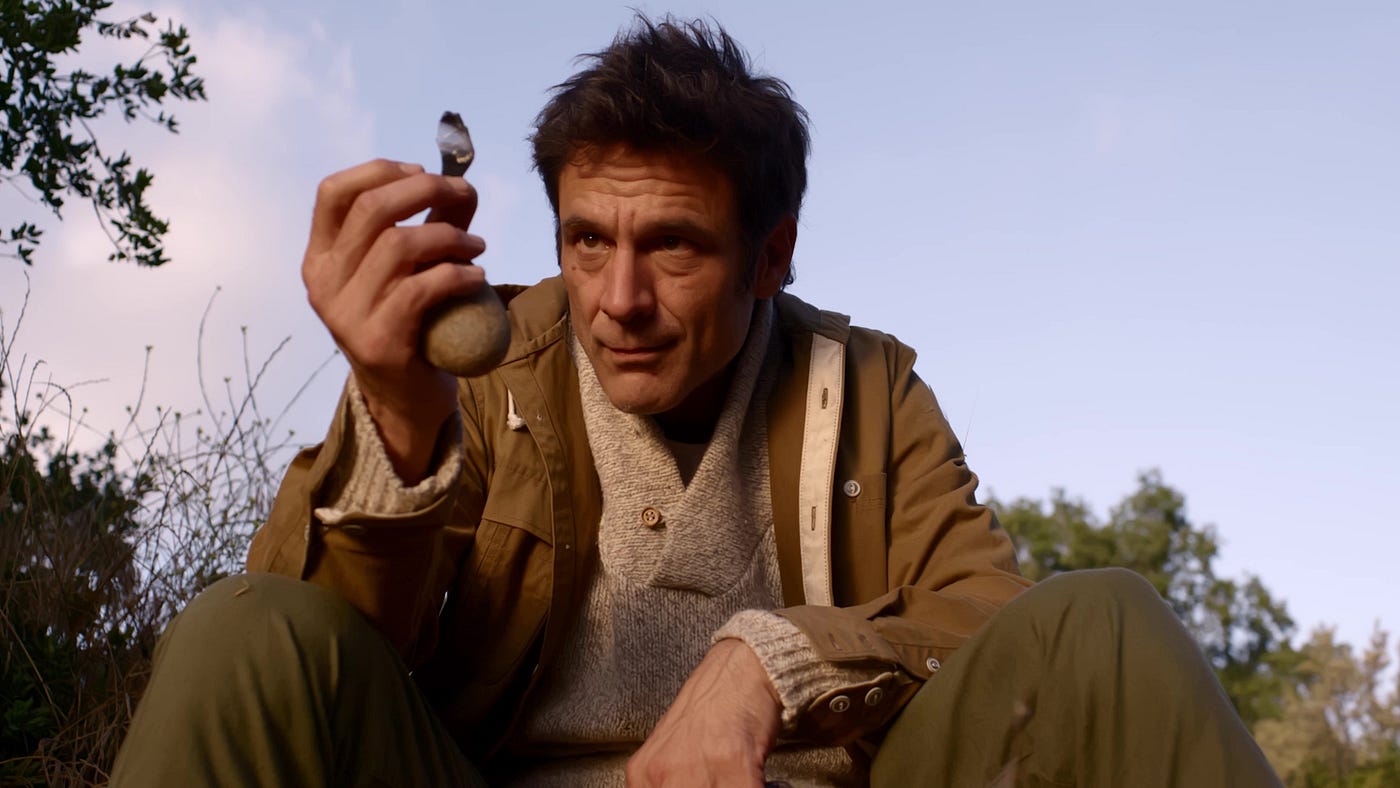
https://images.static-bluray.com/reviews/16333_1.jpghttps://miro.medium.com/v2/resize%3Afit%3A1400/0%2AZeH6XOyObPDRqjRU.jpg

The Man from Earth
(2007)

A Processual Review of Becoming

by R.E. Slater & ChatGPT

“Man is nothing else but what he makes of himself.”
- Jean‑Paul Sartre

“We live forward, but understand backward.”
- Søren Kierkegaard


There are films that rely on spectacle, and then there are films that rely on thoughtThe Man from Earth, written by Jerome Bixby and directed by Richard Schenkman, belongs firmly to the latter. It is, at its core, a philosophical chamber drama - a single-room conversation that unfolds into a meditation on time, identity, purpose, and the evolving nature of truth.

"A Conversation Before Leaving" was a light re-enactment of the film without spoiling the actual content of its characters. However, all that follows will require the reader to stop and watch the film, as we now go on to analyze its characters, topics, and philosophical weight.

In hindsight, what makes the film remarkable - especially in light of processual interests - is that it enacts becoming rather than merely describing becoming.

The Man From Earth 2007 | 1080p


~ SPOILERS BELOW ~


I. The Setting

IA. The Speakers and Their Disciplines

The conversation in The Man from Earth works because each character represents a distinct academic discipline. Their professional backgrounds shape the way they respond to John Oldman’s extraordinary, if not audacious, claim of longevity. What emerges is a kind of miniature intellectual ecosystem, gathered within a single room.

John Oldman, the central figure of the story, is a professor of history. His role in the conversation is that of catalyst. He introduces the thought experiment that suggests he may have lived for fourteen thousand years, and in doing so initiates the dialogue which drives the entire film.

Dan, an anthropologist, approaches the claim through the lens of evolutionary science. His instinct is immediate skepticism, attempting to dismantle John’s story through anthropology and human biological development.

Harry, a biologist, focuses on the physiological implications of such a claim. Could the human body sustain such longevity? His questions probe the biological limits of life itself.

Edith, a scholar of Christian theology and religious studies, finds herself increasingly unsettled as the conversation unfolds, particularly when John hints that he may have been connected to the historical origins of Jesus Christ.

Sandy, an archaeologist, exhibits a greater openness to the possibility being entertained. Her training in uncovering the past makes her more willing than others to suspend immediate disbelief.

Art Jenkins, a senior archaeologist and respected academic, represents the stabilizing authority of institutional scholarship. His role is to defend the established intellectual order.

Will Gruber, a psychologist and psychiatrist, interprets the conversation through the framework of mental health. He considers whether John’s narrative might reflect delusion, trauma, or psychological coping.

Together, these figures create a dynamic interplay of intellectual perspectives.


IB. Why This Group Works Dramatically

Seen symbolically, the characters form a microcosm of humanity’s knowledge systems.

CharacterDisciplineSymbolic Role
JohnHistoryLiving memory
DanAnthropologyEvolutionary science
HarryBiologyPhysical limitation
EdithTheologyFaith and belief
SandyArchaeologyCuriosity about the past
ArtAcademic authorityTradition and institutional knowledge
WillPsychologyThe human mind

Within this small gathering we see science, religion, history, and psychology meeting face to face.

The conversation thus becomes more than a discussion about one man’s claim. It becomes a meeting point of the different ways human beings search for truth.


II. The Premise as Philosophical Catalyst

The narrative premise of the film is deceptively simple.

A departing professor gathers together several colleagues before leaving town. During their conversation he suggests, quietly but seriously, that he may have lived continuously for fourteen thousand years, stretching back to the Upper Paleolithic period.

From this moment forward, the film unfolds almost entirely through dialogue. Skepticism, curiosity, disbelief, fascination, and existential unease ripple through the room.

Yet the premise is not designed to be proven. It functions instead as a philosophical invitation.

Rather than asserting that John’s story is true, the film asks a different kind of question:

What if such a thing were possible?

In this sense the film mirrors the philosophical approach of Process Philosopher, Alfred North Whitehead. It does not insist upon a fixed metaphysical claim. Instead it offers a speculative proposition - an imaginative possibility through which deeper truths may emerge.

The room thus becomes a laboratory of thought in which each participant must renegotiate their assumptions about time, identity, and experience.


III. Identity as Process Rather Than Substance

John Oldman is not presented as a static being possessing a fixed identity. Instead he appears as a continuous accumulation of experience.

He changes names.
He adopts new professions.
He leaves before anyone notices that he does not age.

In this sense, memory becomes the only thread binding his life together.

This depiction resonates strikingly with Whitehead’s understanding of the self. For Whitehead, the self is not a permanent substance but a society of experiences unfolding through timeIdentity arises through the integration of past experiences into present consciousness.

John Oldman can consequently be understood as a dramatic illustration of this principle. His life represents an extended continuity of experience - a living stream of memory stretching across millennia.

And yet, the film quietly presses an even deeper question:

If identity is shaped by memory and adaptation rather than essence, then what ultimately anchors the self?


IV. Time, Memory, and the Weight of Experience

Unlike many narratives about immortality, The Man from Earth does not romanticize endless life.

Instead it presents time as an accumulating burden.

John speaks of languages that no longer exist;
Of cultures that have risen and vanished;
Of relationships that must inevitably end.

Time becomes less like a line and more like sedimentary soil, with layers of experience slowly building upon one after the other.

This image resonates strongly with process philosophy. In process thought, the past never fully disappears. Each moment carries forward the accumulated influence of prior experience.

In this sense the past remains objectively immortal within the present.

John Oldman embodies this condition in dramatic form. He is not simply an old man. He is history itself carried forward through a single stream of consciousness.


V. Religion as an Evolving Narrative

One of the film’s most provocative dimensions concerns religion.

At one point John suggests that he may have once attempted to share ideas of compassion and forgiveness during his travels, and that these teachings later became associated with the figure of Jesus Christ.

Whether this claim is meant literally or metaphorically is never fully resolved.

What matters is the implication that religious traditions may evolve through dynamic, layered reinterpretation and transmission over time.

From this perspective, religious meaning is not static. It emerges through the ongoing interaction between stories, communities, and historical context.

Teachings are remembered, reshaped, translated, and sometimes mythologized.

Such a view resonates with a process-oriented approach to theology, where faith is understood not as a fixed deposit but as an ongoing participatory process.

The religious-cum-faith discomfort this suggestion produces within the room reflects a broader human tension. People often long for certainty in matters of faith. Yet lived history continually reshapes the meaning of inherited traditions.


VI. Knowledge, Skepticism, and the Limits of Certainty

Each participant in the room represents a particular epistemic stance.

  • The scientist seeks empirical proof.
  • The historian remains cautiously open.
  • The psychologist searches for psychological explanations.
  • The theologian defends religious belief.

Yet none of these perspectives ultimately resolves the mystery before them.

Instead, the conversation reveals the limits of certainty itself.

Truth in this context is not delivered as a final conclusion. It emerges through dialogue, questioning, and interpretation.

In process terms, reality is not a finished object waiting to be discovered. It is an ongoing event of interpretation shaped by relationships, perspectives, and experience.


VII. Becoming as the Human Condition

As the discussion unfolds, the central question of the film slowly shifts.

It is no longer simply:

“Is John telling the truth?”

Instead the deeper question becomes:

“What does it mean to exist across time?”

Seen in this light, John Oldman is less a supernatural anomaly and more a dramatic exaggeration of the (continuing) human condition.

Human beings themselves are continually changing:

We adapt to new circumstances.
We reinterpret past experiences.
We carry forward memories that shape who we become.

In this sense, we are all participating in processes of becoming - though our timelines are much shorter.


VIII. A Processual Interpretation

Viewed through a Whiteheadian lens, The Man from Earth can be interpreted as a narrative exploration of process metaphysics.

The film illustrates:

  • the continuity of experience across time

  • the formation of identity through accumulated memory

  • the reinterpretation of traditions through continuous historical change

  • the epistemic humility required in confronting the limits of knowledge

John Oldman becomes less a miraculous figure and more a philosophical thought experiment.

He represents the possibility that identity itself may be nothing more than the ongoing integration of experience.


IX. Why the Film Endures

Despite its modest budget and simple setting, the film has achieved enduring popularity.

Its power lies in the questions it raises.

Human beings long for continuity.
We wrestle with the instability of identity.
We seek meaning within the flow of time.

The film quietly asks:

If one could live long enough to witness the rise and fall of civilizations, would wisdom inevitably follow? Or would such longevity simply deepen the weight of memory?

More profoundly, it invites us to consider whether we ourselves are already personally participating in processes of becoming that we barely recognize around ourselves.


Closing Reflection

The Man from Earth is ultimately less about immortality than about the texture of existence itself.

It suggests that identity is not something given once and for all but something continually formed through experience.

Truth is not something possessed but something pursued.

Meaning is not fixed but emerges through participation in the unfolding story of life.

In this sense the film becomes a cinematic parable of processual becoming.

Human life is not a static declaration. It is an unfolding participation in time, memory, and relationship.


Closing Note: A Doorway to the Series

This story functions as a fitting introduction to the reflections that follow.

It does not attempt to argue why we should care about philosophical questions.

Instead it creates the conditions in which caring becomes unavoidable.

From this point forward the conversation continues through new questions:

Why should we care about reality?
Why should we care about becoming?
Why should we care about others?
Why should we care about truth if it continues to change?

The answers may never arrive in final form.

But the questions themselves invite us into a deeper participation in the unfolding process of life.


After the Conversation
by R.E. Slater

The door closed quietly
behind a man who kept
walking away.

No answers followed him
down the gravel drive,
but many questions had risen.

Behind were a room of scholars
standing among half-packed boxes
amid evening's lengthening shadows.

They had argued about time,
debated about memory,
held stubbornly to the limits of belief.

But none spoke at the moment.
Each were silent in their own way.
Contemplative.

Because somewhere -
between a question, and a story -
something had shifted.

A weight had descended,
and the oldest truth in the room
was not fourteen thousand years old.

It was the realization
that life was not something
one could possess...

Only something
one could participate in
as the oldest of processes in the universe.


R.E. Slater
March 5, 2026
@copyright R.E. Slater Publications
all rights reserved