"Autobiographies of great nations are written in three manuscripts – a book of deeds, a book of words, and a book of art. Of the three, I would choose the latter as truest testimony." - Sir Kenneth Smith, Great Civilisations

"I must write each day without fail, not so much for the success of the work, as in order not to get out of my routine." - Leo Tolstoy

I have never believed that one should wait until one is inspired because I think the pleasures of not writing are so great that if you ever start indulging them you will never write again. - John Updike

"The life of every man is a diary in which he means to write one story, and writes another; and his humblest hour is when he compares the volume as it is with what he vowed to make it." - J.M. Barrie, Peter Pan

Poetry is the shadow cast by our streetlight imaginations." - Lawrence Ferlinghetti


[Note - If any article requires updating or correction please notate this in the comment section. Thank you. - res]


Thursday, October 20, 2011

Geroge Herbert - Commentary on the Christian Poem "Easter Wings"


Easter Wings
from The Temple (1633), by George Herbert


The same poem turned about on itself
forms a pair of wings


The poem is usually printed in modern anthologies as seen above. In the 1633 edition. the poem is printed as seen in the scanned copy below, making it look more like its title.


For a different placement here are copies of the Williams Manuscript
(also called MS. Jones B 62 in Dr. Williams Library)


The Bodleian MS (also called MS Tanner)
page 1 of "Easter-wings"


~ ~ ~ ~ ~ ~ ~ ~ ~ ~ ~ ~

George Herbert, The Priest to the Temple - http://www.ccel.org/ccel/herbert?show=worksBy


George Herbert - (1593-1633), Poet and divine

George Herbert was born to a noble family in Wales; his mother was patron to John Donne who dedicated his 'Holy Sonnets' to her. He was educated at Westminster School and Trinity College, Cambridge, where in 1620 he was elected to the prestigious post of Public Orator.

His first two sonnets were sent to his mother in 1610. On the theme that the love of God is a worthier subject for verse than the love of woman. They foreshadowed his future religious and poetic inclinations, but at first Herbert seemed bent on a secular career, much involved in court life and Member of Parliament for Montgomery in Wales from 1624-5. His only published verse during this period was in Greek and Latin, for formal occasions.

In 1627, however, he resigned as Orator and was ordained a priest, becoming rector at Bemerton in Wiltshire where he was noted for his diligence and humility, traits reflected in his poetry which also expresses the conflict between the religious and worldly life.

When he realized he was dying of consumption, he sent a collection of his poems in manuscript to his friend Nicholas Ferrar to judge whether to burn them or publish them. The result was The Temple, religious poems using common language and rhythms of speech, published to enormous popular acclaim and running to 13 editions by 1680.

Also published after his death, in 1652, was A Priest to the Temple: Or the Country Parson, his Character and Rule of Life homely, prose advice to country clerics.


~ ~ ~ ~ ~ ~ ~ ~ ~ ~ ~ ~

Related Criticism to Herbert's poem, "Easter Wings"
http://www.ccel.org/h/herbert/temple/Easterwings.html

Joseph Addison, in The Spectator, No. 58, Monday, May 7, 1711, argued against ancient Greek poems in the shape of eggs, &c. as false wit. He continued:
Mr. Dryden hints at this obsolete kind of Wit [shaped poems] in one of the following Verses in his Mac Fleckno; which an English Reader cannot understand, who does not know that there are those little Poems abovementioned in the Shape of Wings and Altars.

       . . . Chuse for thy Command
Some peaceful Province in Acrostick Land;
There may'st thou Wings display, and Altars raise,
And torture one poor Word a thousand Ways.
This Fashion of false Wit was revived by several Poets of the last Age, and in particular may be met with among Mr. Herbert's Poems; . . . .
Professor's rebuttal (without degrading Addison's perception or gift for expression):

When devices are dropped into/on to a work, they are just ornaments scattered on pseudo-art/kitsch (in this Addison rings true). When ornaments are integrated into the meaning of the work, they loose their ornamentation and become part of the meaning, working together in the poem. Herbert converted the use of popular devices and tricks of his day into his vision of the world, giving an understanding beyond the mundane. [In a similar way that God takes clay and makes something better out of it.] (JRA)

Art Student's Addenda:

This is the difference between Baroque and Classical Art. Baroque art is famous for its ornaments, but details support the concept of the work in Classical Art.

Music Student's Coda:

The history of music classes Bach as baroque, but his "ornaments" advance and echo the message of the piece and hold the entire work together. As Albert Schweitzer shows concerning the Preludes for Organ. In this way Bach was closer to the Classic Period than most give him credit.


The following is quoted "as is" from a University of Texas at Austin page no longer on the Internet:

Interchange 7 on
George Herbert


Herbert II

Leslie Barnett remarks on "Easter Wings":

"With thee
Let me combine,
And feel this day thy victories:
For, if I imp my wing on thine,
Affliction shall advance the flight on me."

I feel that this poem is saying that you can't just "create" someone then leave them on their own to grow. They will not grow into a strong person with good qualities. A person needs nurturing, love, and support before they can take "flight" on their own. the last line says this more directly, if he puts his wing just over the other persons then their strenght will push him to be strong and begin his own flight. The reference to the Lord's creation of man is only symbolic, I feel that he is speaking indirectly about parenting and society's affect on a person.

Cecile Coneway:
I do not understand what the last line ("Affliction shall advance the flight on me") is saying. How does affliction fit into it?

Todd Erickson:
Why is the reference to the Lord's creation only symbolic??

Colleen Ignacio:
Knowing Herbert, it was probably strictly about religion.

Leslie Barnett:
i think affliction means like friction, when the one wing moves and begins flight the other will recieve the initial push to do the same.

Todd Erickson:
Cecile
Flight could have multiple meanings:
uplifting of spirit, or running away

Shannon Byrne:
I felt that he was talking about man and the creation. I thought he was saying that God created man and gave man everything, yet man "foolishly" lost what he gave and became more and more corrupt. The poet is asking for God to let him sing the Lord's praises and by so doing he will fall in the sight of others and this fall will enable him to be closer to God.

Todd Erickson:
Shannon why does he use 'fall'??? That sounds so counterproductive , when he's wanting to fly.

Alicia Lane Jones:
Correct me if I am wrong,however, if we look at the title, maybe THIS poem reflects the second coming of Christ - didn't that happen on Easter - or does easter refer to something else?

Kalisha James:
Affliction seems to mean some sort of punishment in this passage. It advancing the flight in me refers to punishment maybe leading the speaker to do right and therefore advancing his flight to heaven.

Shannon Byrne:
I thought affliction meant that if he is hurt by others because he is "flying" with God his "flight " will advance or his life will be happier.

Chad Dow:
I think that he is asking God to forgive him for all the wrong things he has done. He is simply wanting to be ackowledge by God and asking for help and strength to change and correct his life, so that he can sing wonderful praises up to God.

Jignesh Bhakta:
Alicia, you are right it is a poem of the second coming of Christ

Shannon Byrne:
Todd:
I'm not really sure except maybe he means fall from the graces of society. Maybe he's thinking that if he follows God he will be persecuted.

Leslie Barnett:
another part that seems to support this interpretation would be:

"And still with sickness and shame
Thou didst so punish sinne,
That I became
Most thinne."

it seems to be refering to societies tedency to shy away from those that need help the most. when someone looks sickly we don't want to help and that only makes it worse. agood example would be the homeless.

Xavier Alfaro:
colleen ....i agree, it had to be about religion. he must be casting a sermon down. the wings will only protect you for so long. soon you must make choices. make the right one or else. what the else is, i do not know

Kalisha James:
Alicia, I think you're onto something. Easter is about the rising of Christ. It coould, in fact be speaking of the second rising of Christ.

Shannon Byrne:
Alicia,
I think your right.

Jignesh Bhakta:
What is the deal with the shape of the poem?

Alicia Lane Jones:
you know when you are born you don't have any memory of God - it may take a while to find him again. Maybe this is saying that at his tender age he was foolish and not looking in the right places, but now he has found God and wants to fly

Todd Erickson:
wings wings

Chad Dow:
Jignesh,
I think it is to symbolize the wings and the uplifiting flight the guy is about to go on.

Leslie Barnett:
i feel that in both "redemption" and this poem i failed to see the religious connections/interpretations but what shannon said about this poem and what we discussed in class do make sense.

Shannon Byrne:
Alicia,
wha does That I became most thinne mean?

Xavier Alfaro:
Alicia....you are getting pretty deep. I kind of agree though

Kalisha James:
Jignesh, I think the shape resembles a bird, possibly a dove. A dove is used a lot in the Bible to symbolize some sort of overcoming or redemption, the title does also have the word "wings" in it.

Cecile Coneway:
I thought the quote "And still with sickness and shame\Thou didst so punish sinne,\That I became\Most thinne" is illustrating God's way of letting people deal with their sins and suffer their consequences regardless of their physical state.

Leslie Barnett:
looking at your interpretation i think maybe he became thin because sin was punished with sickness and he was sinning by not believing or following?

Kalisha James:
Shannon, I know you asked Alicia, but i think of "thinne" meaning a moral thinness. Obviously the speaker has done some wrongs in order to be punished.

Shannon Byrne:
Cecile,
Is "Thinne" thin or thine

Colleen Ignacio:
I think in his own personal way, he's renewing his vows with God. Easter probably had something to do with it. He says: "My tender age in sorrow did beginne. . .that I became most thinne." He's remembering what part God plays in his life and wants to continue down that path.

Cecile Coneway:
Shannon: I think it's thin.

Xavier Alfaro:
i do to

Cecile Coneway:
It's kind of neat the way the poem's shape becomes the narrowest when it says "Most thinne".

Shannon Byrne:
Kalisha,
If its moral thinness what do the lines before it mean

Alicia Lane Jones:
Do you all think thinne refers to thin or thine?

Leslie Barnett:
what is thine?

Xavier Alfaro:
thin. what's thine

Jignesh Bhakta:
thine?

Leslie Barnett:
oh, maybe most his?

Kalisha James:
Alicia, Are you saying that before we are born we know God, but when we are born we forget Him?

Shannon Byrne:
thine means that this poet is God's

Cecile Coneway:
Most his?

Leslie Barnett:
thy, thine

Alicia Lane Jones:
thine means yours

Vocal arrangement of Easter Wings (White, Medium-high voice and piano, 430-411 For Sale.)

Background: song of a true lark
Optional music: Welsh folksong "Rising of the Lark" arranged by Red Dragon


Wednesday, October 19, 2011

What is Visual Poetry?

Easter Wings by George Herbert


Definition of CALLIGRAM

: a design in which the letters of a word (as a name) are rearranged so as to form a decorative pattern or figure (as for a seal) — compare monogram

From Wikipedia

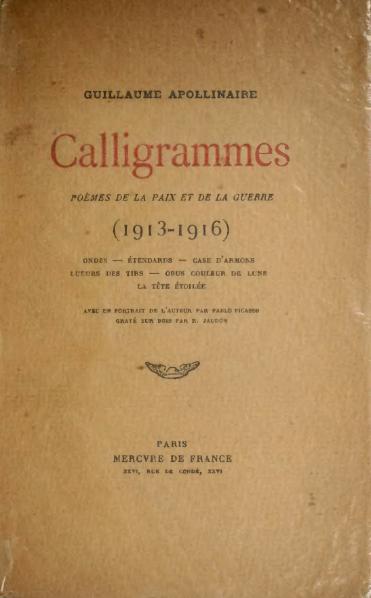
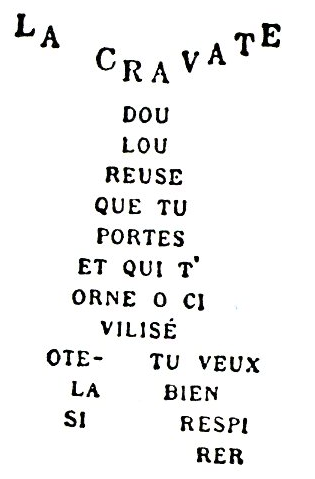
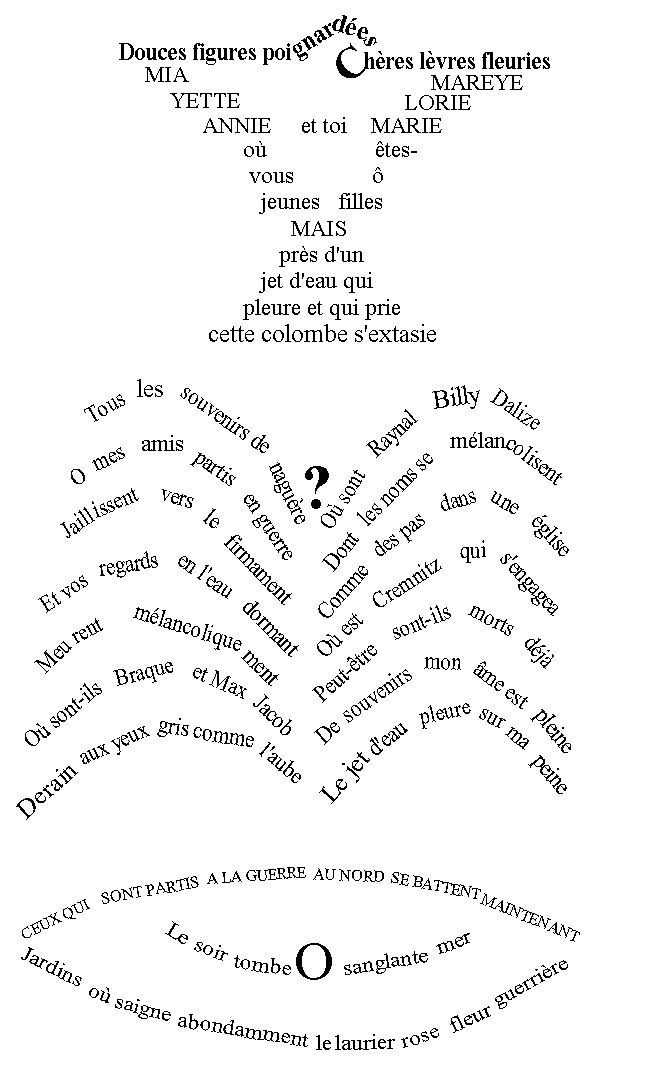
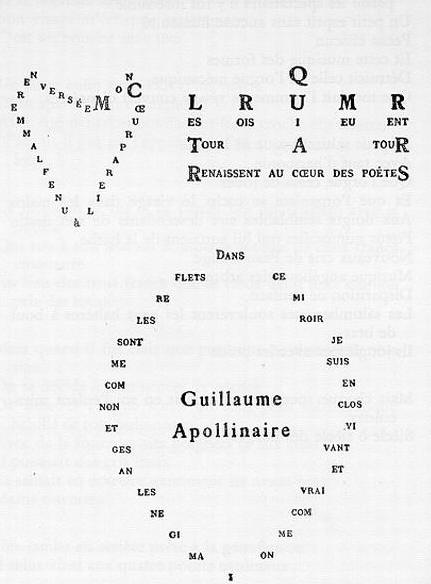
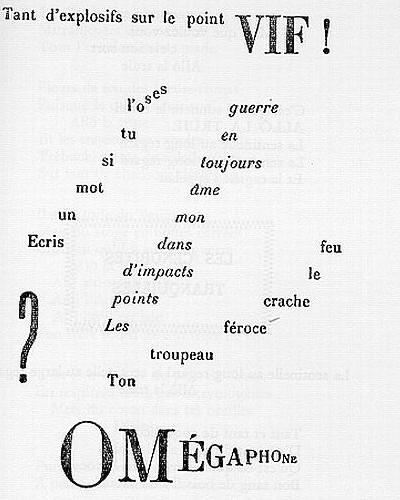
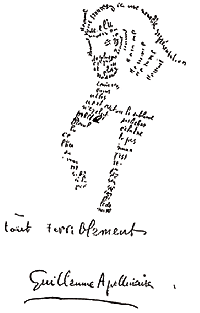
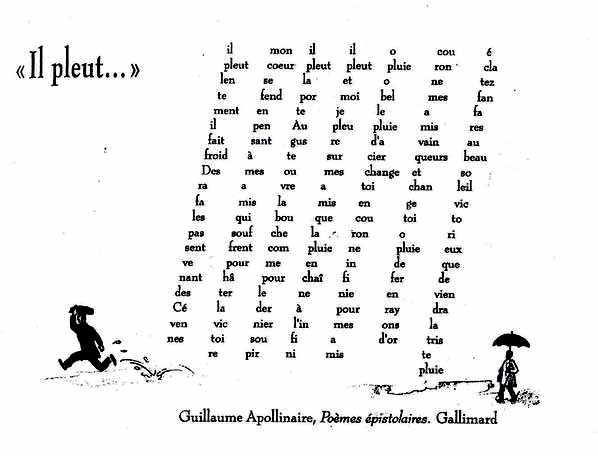
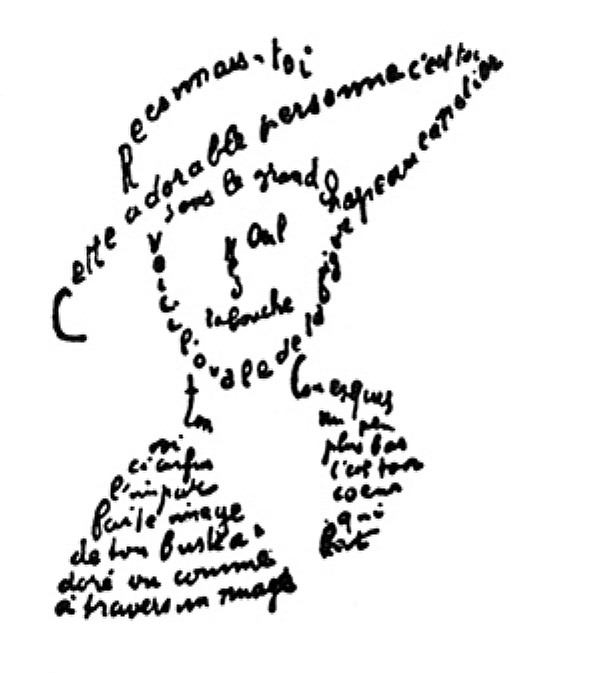
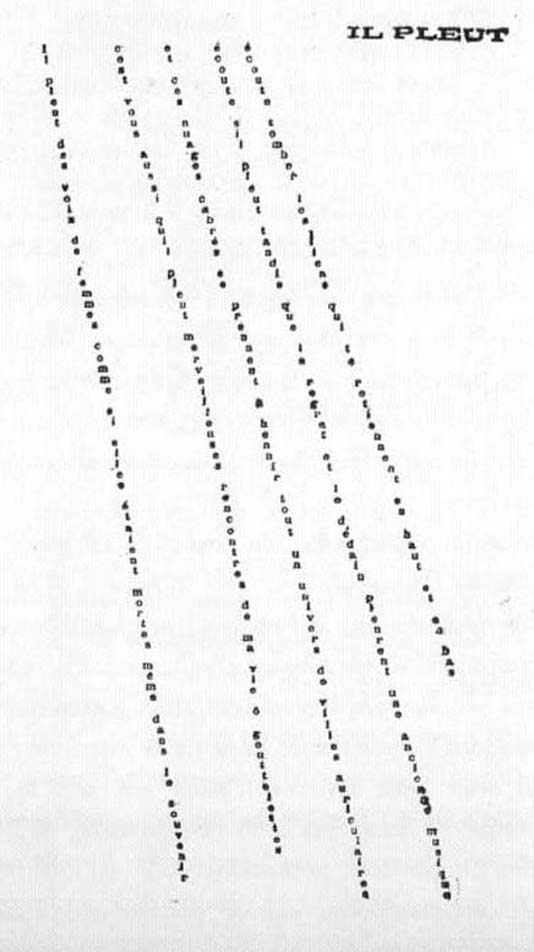
A calligram is a poem, phrase, or word in which the typeface, calligraphy or handwriting is arranged in a way that creates a visual image. The image created by the words expresses visually what the word, or words, say. In a poem, it manifests visually the theme presented by the text of the poem. Guillaume Apollinaire was a famous calligram writer and author of a book of poems called Calligrammes. His poem written in the form of the Eiffel Tower is an example of a calligram.


EARLY VISUAL POETRY

Famous Calligrammes, by Apollinaire

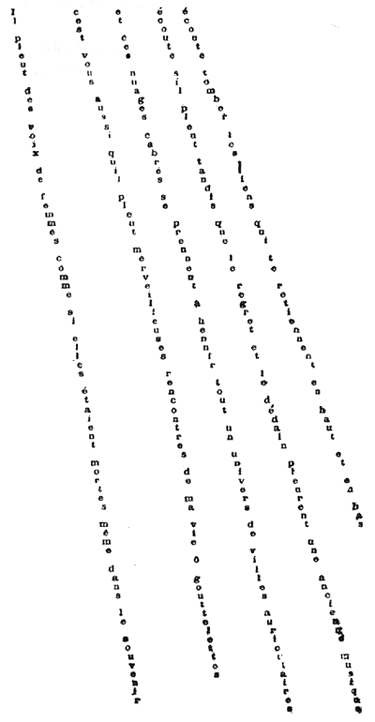
Calligrammes, subtitled Poems of war and peace 1913-1916, is a collection of poems by Guillaume Apollinaire, and was first published in 1918 (see 1918 in poetry). Calligrammes is noted for how the typeface and spatial arrangement of the words on a page plays just as much of a role in the meaning of each poem as the words themselves - a form called a calligram. In this sense, the collection can be seen as either concrete poetry or visual poetry. Apollinaire described his work as follows:

The Calligrammes are an idealisation of free verse poetry and typographical precision in an era when typography is reaching a brilliant end to its career, at the dawn of the new means of reproduction that are the cinema and the phonograph.

                             - Guillaume Apollinaire, in a letter to André Billy


Calligrammes by Apollinaire -

http://www.google.com/search?q=apollinaire+calligrammes&hl=en&qscrl=1&nord=1&rlz=1T4ADRA_enUS421US423&biw=1539&bih=822&site=webhp&prmd=imvnsb&tbm=isch&tbo=u&source=univ&sa=X&ei=7SafTtlAg-SIAu_BhYYB&sqi=2&ved=0CCAQsAQ


Apollinaire’s most celebrated Calligrammes


CONTEMPORARY VISUAL POETRY

Peter Ciccariello’s “Credible report III”

Image by [Peter Ciccariello’s](http://invisiblenotes.blogspot.com/) “Credible report III”

Visual Poetry

Visual poetry (also called VisPo and concrete poetry) is poetry in which the visual element is as important—or sometimes more important—than the verbal one. It’s meant to be seen. All poetry has a visual component, but visual poetry self-consciously emphasizes and exploits images in the creation of meaning. To many, these poems are not just literary works, but works of art.

While some claim that visual poetry has existed since humanity’s first use of writing, many see its modern Western beginnings either in 1896 with Mallarmé’s Un Coup de Dés or around 1914 with the work of Guillaume Apollinaire and Italian Futurist F.T. Marinetti.

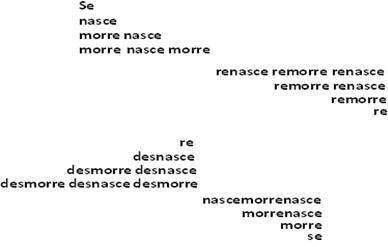
Visual poetry experienced a renaissance in the 1950s and 1960s on the European continent and in Brazil with the movement known as concrete poetry.

Eugen Gomringer, “Wind”

Haroldo de Campos, “Nasce Morre”

Throughout the ‘50s and ‘60s—and afterwards—people also created poetry incorporating more complex pictures. Some labeled it “visual poetry” as a category distinct from concrete poetry. How concrete and visual poetry are classified and related to each other is still open to debate.

Carol Stetser, “Hierogram”

K.S. Ernst and Sheila Murphy, “Vortextique”


Today many visual poets have incorporated sound and motion in their poetry: http://vispo.com/

Visual poetry takes a variety of forms. The genre has an elasticity that leads to ever-widening avenues for creation of meaning. The links to the poets here give are just a tiny taste of its rich world.


More Visual Poetry Images -

L'oiseau_et_le_bouquet

Caligrafia_arabe_pajaro_svg


Bismillah


Figurengedicht_1638


Heinritzh Sales voir son site


ebon heath: on visual poetry
DateSunday, May 24, 2009 at 9:33AM
Ebon Heath is a Brooklyn-based artist/graphic designer with a love of typography and an interest in giving a dynamic, three-dimensional and physical representation to all the "visual noise" that permeates everyday city life. His work is very much influenced by hip hop. Both lyrically and rhythmically. He sees the work as a way to "cleanse or release content contained inside us."

His work honors *craft* in a heavily digital world. I love the statement he is making. And what a gorgeous statement it is.

Read the article on Yatzer to learn more.

Ebon Heath
http://www.yatzer.com/1690_ebon_heath_and_his_visual_poetry


Ebon Heath
http://www.yatzer.com/1690_ebon_heath_and_his_visual_poetry


Ebon Heath
http://www.yatzer.com/1690_ebon_heath_and_his_visual_poetry


The popular song goes that words don’t come easy, and, ironically enough, this is exactly the sense one has when trying to express himself in front of Ebon Heath’s typographic mobiles. Heath is one of the most promising artists of the moment and his take on typography is pure visual poetry. Words never looked more astonishing, they form their own structures in a short of a rebellion, they dance and move and yet they stand still. In Heath’s universe, words go out of their suffocating homes, they become alive and they tell us their amazing stories.


Ebon Heath
http://www.yatzer.com/1690_ebon_heath_and_his_visual_poetry


ADVERTISEMENTS, BULLETINS, PLAY BILLS AS VISUAL POETRY


mix of calligrams (calligramme, calligramma) by Laura Ruggeri ©1995-2005


Mathematical Masterpieces: Making Art From Equations

Artists use math to create works of art to rival gallery masterpieces.

Bunny-Squared

This is a self-referential bunny — a sculpture of a bunny, the surface of which is tiled by 72 copies of the word "Bunny." This piece is part of a larger series of "autologlyphs," following on from HS's "Sphere Autologlyph" from the 2010 Bridges art exhibition. An autologlyph is a word written or represented in a way which is described by the word itself. This style of autologlyph combines Escher-style tessellation with typographical ideas related to ambigrams.

The bunny was created using a technique published by CSK for transferring a symmetric design to a suitably parameterized mesh surface. We modified the technique to require a quarter as many copies of the fundamental domain as compared with the original version. This allowed us to send a smaller (and more affordable) model to the 3D printer. The design of the word "Bunny" was produced using Adobe Illustrator, then thickened in 2D, triangulated, mapped to the 3D surface, and extruded into a thin shell for manufacture.

“Bunny” Bunny by Craig S. Kaplan and Henry Segerman. Plastic, Selective-Laser-Sintered.